Execution Diagnostics for Improving Delivery Predictability in 2026
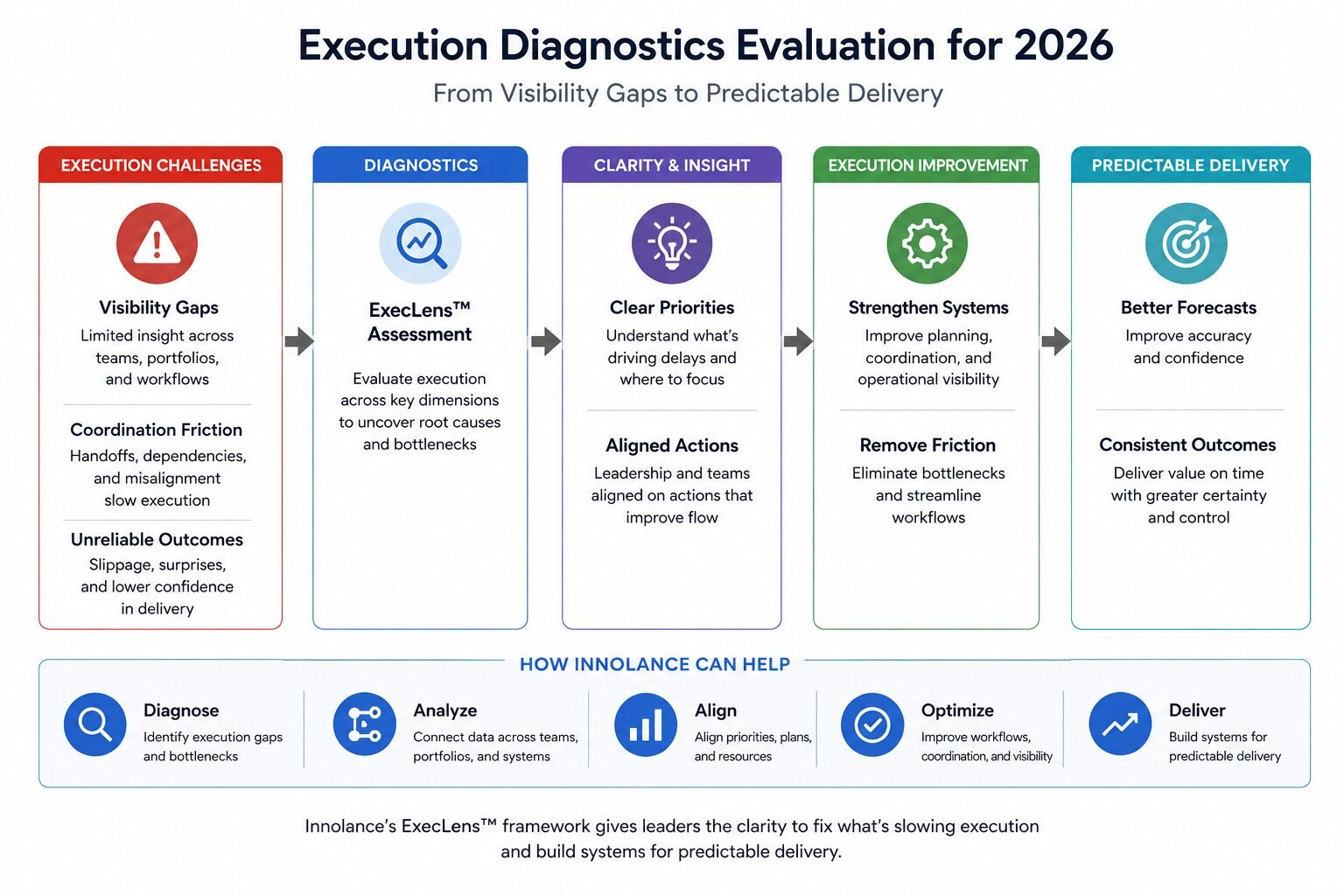
Organizations entering 2026 face increasing pressure to improve delivery predictability while managing growing operational complexity. As teams, portfolios, workflows, and leadership systems scale, execution visibility often becomes fragmented, making it difficult for leadership to clearly understand where delivery friction is developing.
Roadmap slippage, delayed decision-making, unreliable forecasting, disconnected planning, and coordination breakdowns frequently emerge when organizations lack execution clarity across operational and strategic systems.
Why Delivery Predictability Becomes Harder as Organizations Scale
As organizations grow, execution becomes increasingly distributed across multiple teams, portfolios, technologies, operational processes, and leadership functions. While growth creates new opportunities, it also introduces additional layers of coordination complexity that can reduce organizational visibility.
Without connected execution intelligence, leaders often struggle to determine:
- Where delivery friction is accumulating
- Which dependencies are creating delays
- Why forecasting confidence is declining
- How planning decisions affect execution outcomes
- Which operational bottlenecks are disrupting delivery flow
These visibility gaps often lead to inconsistent decision-making and reduced confidence in roadmap commitments.
What Execution Diagnostics Evaluate
Execution diagnostics provide organizations with a structured way to evaluate how work flows across teams, planning systems, operational workflows, and leadership reporting structures.
Key Areas of Diagnostic Assessment
Critical evaluation areas include:
- Portfolio alignment
- Execution flow visibility
- Workflow transparency
- Leadership telemetry
- Dependency coordination
- Operational reporting accuracy
- Organizational bottlenecks affecting delivery predictability
By examining these systems collectively rather than in isolation, organizations gain a clearer understanding of the factors influencing delivery performance.
The Cost of Fragmented Visibility
Without connected visibility across execution systems, organizations often operate from fragmented data sources and inconsistent operational truths.
This fragmentation can create:
- Conflicting priorities across teams
- Delayed leadership decisions
- Reduced forecasting accuracy
- Misaligned planning assumptions
- Inefficient resource allocation
- Increased delivery volatility
As a result, organizations frequently address symptoms rather than identifying the underlying execution constraints affecting performance.
Understanding Coordination Friction Across the Organization
Growing organizations often experience increasing coordination friction between product, engineering, operations, customer-facing teams, and leadership functions.
As complexity rises, isolated reporting systems and disconnected operational processes make it harder to identify the root causes behind:
- Delayed delivery
- Execution inefficiencies
- Communication breakdowns
- Operational instability
- Reduced delivery confidence
Aligning Planning, Execution, and Leadership Visibility
Improving execution clarity helps organizations create stronger alignment between:
- Strategic planning
- Operational execution
- Leadership decision-making
- Delivery outcomes
When leaders have greater visibility into execution flow, they can make more informed decisions, resolve bottlenecks faster, and improve organizational predictability.
How ExecLens™ Improves Execution Clarity
Innolance helps organizations uncover execution gaps through ExecLens™, an execution diagnostics framework focused on delivery predictability, organizational visibility, and operational intelligence.
ExecLens evaluates execution systems across:
- Portfolio coordination
- Team alignment
- Workflow visibility
- Leadership reporting
- Operational bottlenecks
- Delivery constraints
Rather than focusing solely on team performance metrics, ExecLens examines how execution flows across the broader organizational system.
Building Predictable Delivery Through Operational Intelligence
By helping organizations establish clearer execution telemetry, stronger alignment systems, and improved operational visibility, Innolance enables leadership teams to:
- Improve forecasting confidence
- Reduce coordination friction
- Strengthen leadership visibility
- Increase execution transparency
- Build more predictable delivery systems
Accelerating Value Delivery Through Execution Clarity
Organizations that improve execution clarity gain a stronger understanding of how work flows across teams, portfolios, workflows, and leadership systems. This visibility allows leaders to identify execution bottlenecks earlier, improve organizational alignment, and create the operational intelligence required for predictable delivery in increasingly complex environments.