Organizations rarely lose delivery predictability because teams are not working hard enough. In most cases, delivery instability develops because leadership lacks clear visibility into how work actually flows across teams, portfolios, operational systems, and cross-functional dependencies. As organizations scale, execution flow becomes increasingly difficult to manage. Work moves through multiple planning layers, approval structures, operational workflows, and delivery teams, creating hidden bottlenecks that traditional reporting often fails to detect early enough. Flow metrics help organizations uncover these delivery constraints before they create larger execution failures.
Many organizations rely on output-focused KPIs such as utilization rates, sprint velocity, roadmap completion percentages, or individual productivity metrics. While these indicators may provide localized performance visibility, they often fail to explain how efficiently execution moves across the broader organization. Teams may appear productive while delivery timelines continue slipping, dependencies remain unresolved, priorities shift constantly, and operational bottlenecks accumulate beneath the surface. Without execution clarity across the full delivery system, organizations struggle to understand where work is slowing down and why predictability continues to decline.
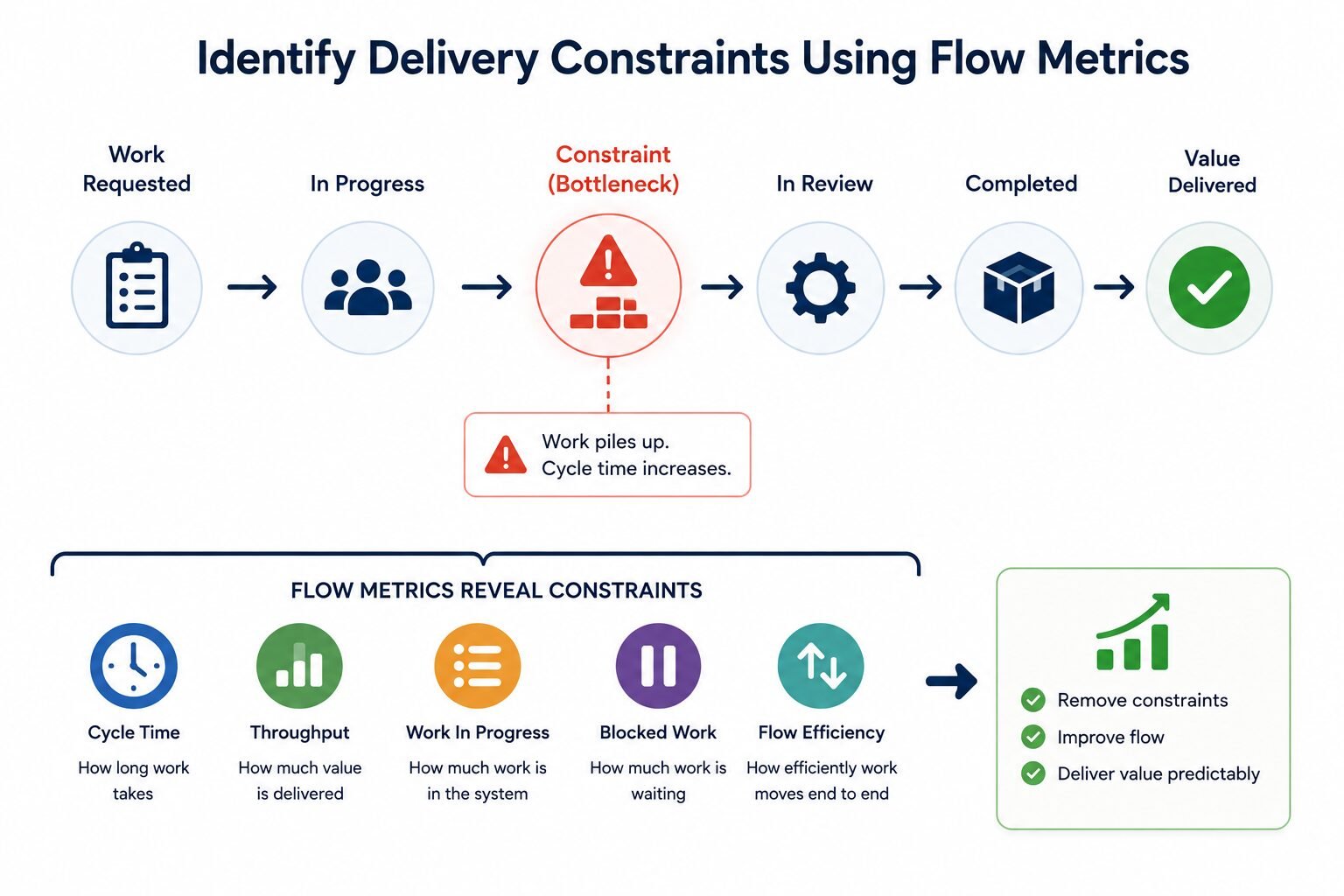
Flow metrics provide organizations with a more accurate view of execution health by evaluating how work progresses through operational systems over time. Instead of focusing only on activity completion, flow metrics help leadership understand cycle time stability, workflow congestion, dependency buildup, coordination delays, blocked work patterns, and execution bottlenecks across delivery pipelines. These metrics reveal how organizational friction impacts delivery flow and where operational constraints are limiting execution performance.
Delivery constraints often emerge when organizations scale faster than their coordination systems evolve. Teams begin operating from different priorities, operational visibility becomes fragmented, and planning systems lose alignment across portfolios and leadership structures. Work accumulates in approval stages, dependencies remain unresolved for extended periods, and teams become overloaded with partially completed initiatives. Even when dashboards continue showing positive performance metrics, execution flow may already be deteriorating beneath the surface.
One of the most common delivery constraints is workflow congestion. When too much work enters the system simultaneously, teams experience reduced focus, slower execution cycles, delayed feedback loops, and increased dependency complexity. Organizations frequently mistake high activity levels for strong execution performance, even though overloaded systems reduce delivery predictability and operational confidence. Flow metrics help leadership identify when excessive work-in-progress is slowing execution and creating coordination instability across operational workflows.
Dependency delays are another major source of delivery friction. As organizations grow, cross-functional dependencies become harder to coordinate across engineering, product, operations, customer-facing teams, and leadership structures. Delayed handoffs, unclear ownership, and fragmented planning systems create invisible execution bottlenecks that traditional KPI reporting may not capture effectively. Flow metrics expose where work repeatedly stalls, where queues continue growing, and where execution flow breaks down between teams or operational systems.
Leadership visibility also plays a critical role in identifying delivery constraints. Many organizations operate with disconnected reporting systems that provide isolated operational snapshots rather than connected execution intelligence. This limits forecasting confidence and makes it difficult to distinguish between temporary delivery slowdowns and systemic operational risks. Flow metrics provide a more dynamic operational view by helping leadership understand where work accumulates, where execution variability increases, and where coordination friction is disrupting delivery stability.
Innolance helps organizations identify these execution constraints through ExecLens™, an execution diagnostics framework focused on execution clarity, operational visibility, and predictable delivery. ExecLens evaluates how work flows across teams, portfolios, workflows, and operational systems to uncover the coordination friction, workflow bottlenecks, and visibility gaps slowing execution performance. Rather than focusing solely on isolated team metrics, ExecLens helps leadership understand the broader operational systems affecting delivery predictability.
By improving execution visibility, operational intelligence, and organizational alignment, Innolance enables organizations to identify delivery constraints earlier, reduce execution friction, strengthen forecasting confidence, and build more predictable delivery systems across the enterprise. Organizations that improve flow visibility gain stronger leadership clarity into execution performance, operational bottlenecks, dependency risks, and workflow stability, creating a more scalable foundation for predictable value delivery as complexity continues increasing in 2026 and beyond.