Execution Problems in Organizations That Slow Delivery
As organizations grow, execution becomes more complex. Teams work harder, but progress becomes harder to predict. These challenges often signal deeper alignment and coordination issues across teams.

Why Execution Problems Keep Increasing
Many organizations reach a point where execution begins to feel harder than it should. Despite capable teams and strong intentions, leaders start noticing patterns that signal systemic issues.
ExecLens by Innolance helps leadership teams diagnose the systemic issues that slow execution and reduce delivery predictability.
Common Execution Problems That Slow Delivery
Delivery Predictability Problems
Even when teams are working hard, progress begins to feel slower and less predictable. Priorities and planning practices are no longer aligned with organizational scale.
Busy Teams, Inconsistent Outcomes
Teams work intensely, yet results vary. This indicates a lack of clarity around priorities, capacity, or dependencies across the system.
Cross-Team Coordination Gaps
As work spans multiple teams, unmanaged dependencies become bottlenecks. Small gaps compound into significant delivery delays.
Lack of Execution Visibility
Status updates often fail to reveal underlying conditions. Leaders struggle to identify where intervention is most needed without deeper insights.
Delayed Strategic Initiatives
Strategic initiatives consistently take longer than expected. Individual team performance is high, but the overall system lacks efficiency.
Systemic Friction
Execution challenges are rarely about lack of effort. They emerge when complexity grows faster than execution clarity.
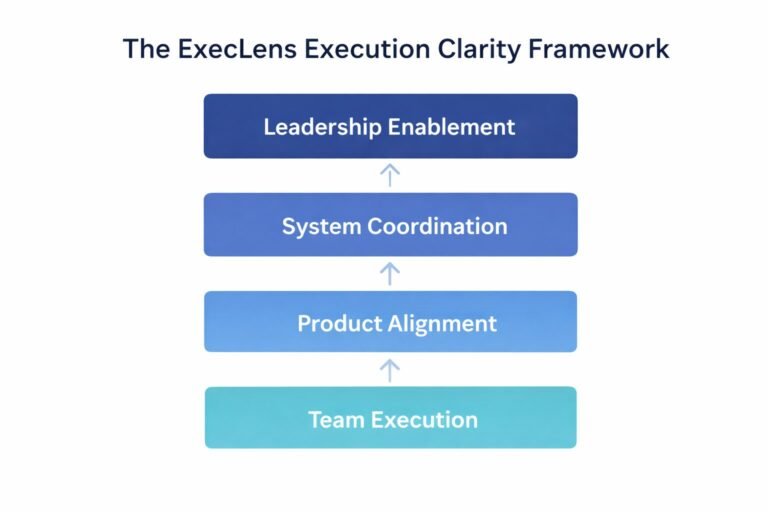
Addressing Execution Problems Requires System-Level Insight
Why Strategy Fails Execution
Execution challenges are rarely caused by lack of capability. They usually emerge when organizational complexity grows faster than execution clarity.
Execution Alignment Problems
Misalignment between teams and leadership on priorities and decision-making slows down every initiative.
Delivery Bottlenecks
Identifying where work gets stuck across teams is critical to restoring flow and predictability.
Increasing Complexity
Scaling without corresponding clarity creates friction that drains organizational energy and slows delivery.
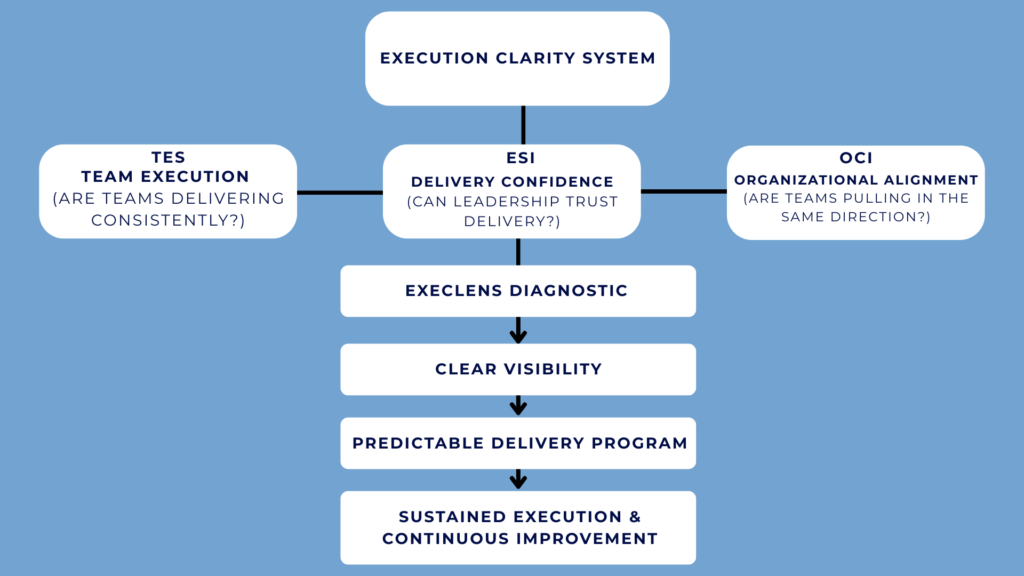
Execution Clarity Assessment (ExecLens)
Team Delivery Score (TDS)
How consistently delivery teams complete work and maintain predictable execution. We analyze the discipline and stability at the team level.
Execution Stability Index (ESI)
How stable the broader delivery system is across teams, dependencies, and planning cycles. This reveals cross-team friction.
Organizational Clarity Index (OCI)
How effectively leadership systems support predictable value delivery through clear priorities and decision-making.
How to Recognize Execution Problems Early
Many execution challenges begin gradually and become visible only after delivery timelines begin slipping or coordination effort increases.
Leaders often notice early signals such as:
- Teams working harder but outcomes becoming less predictable
- Strategic initiatives progressing slower than expected
- Dependencies between teams causing unexpected delays
- Delivery commitments becoming harder to forecast
- Increasing effort spent on coordination rather than delivery
These patterns often indicate that the organization’s execution system has become misaligned as the company grows.
Before introducing new tools, processes, or organizational changes, leadership teams benefit from understanding how execution actually operates across teams.
The ExecLens diagnostic helps reveal the systemic conditions influencing execution performance and delivery predictability.

Improve Delivery Predictability Without Adding Headcount
The Innolance Predictable Delivery Program (PDP) helps leadership teams fix the structural gaps that slow delivery and create misalignment.
- Align Priorities: Ensure teams work on what actually matters.
- Improve Flow: Move work predictably across teams.
- Reduce Friction: Eliminate cross-team delays.
- Restore Confidence:Predictable timelines and outcomes.
Frequently Asked Questions
Why does strategy fail execution in organizations?
Strategy fails execution when there is a lack of alignment between leadership priorities, team capacity, and cross-team coordination. As organizations grow, complexity increases, and without clear execution systems, delivery becomes inconsistent.
Why are teams busy but delivery is slow?
Teams can appear busy when effort is high, but delivery slows due to unclear priorities, unmanaged dependencies, and lack of coordination across teams. Without execution clarity, effort does not translate into outcomes.
What are common execution problems in organizations?
Common execution problems include delivery predictability issues, cross-team coordination challenges, lack of visibility into execution, and strategic initiatives taking longer than expected.
How can organizations improve delivery predictability?
Organizations improve delivery predictability by aligning priorities, improving coordination mechanisms, reducing execution friction, and diagnosing systemic issues through structured assessments.
Ready to Restore Execution Clarity?
If your organization is experiencing execution challenges similar to the ones described here, the first step is understanding how your delivery system actually operates.
The ExecLens diagnostic provides leaders with the insight needed to identify execution constraints and restore predictable value delivery.