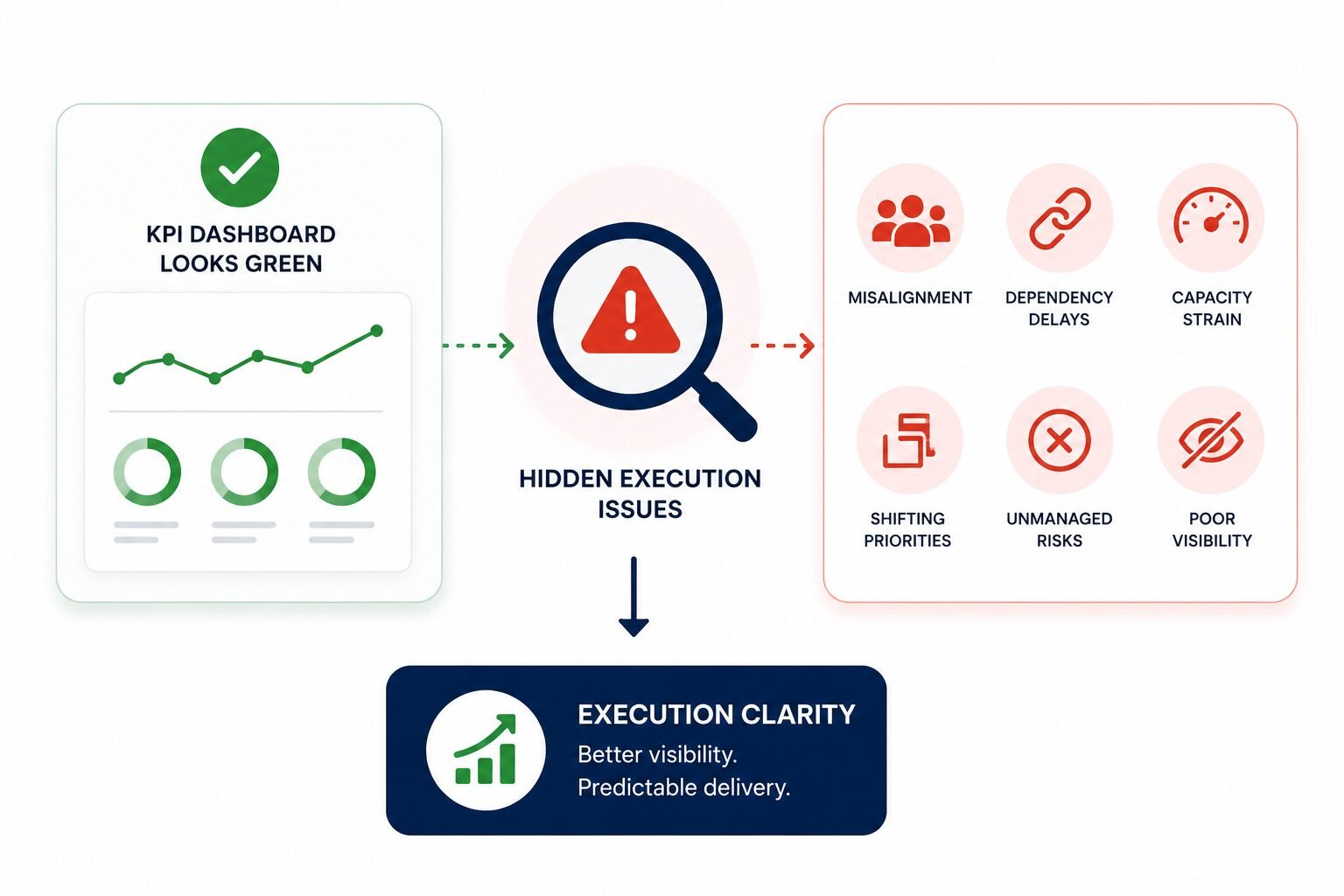
Projects rarely fail without warning signs. In most organizations, delivery instability begins developing long before leadership teams recognize visible operational risk. Dashboards continue showing green KPIs, status reporting remains positive, sprint metrics appear healthy, and portfolio reporting suggests execution is progressing according to plan. Yet beneath these surface-level indicators, organizations often experience growing coordination friction, dependency delays, planning instability, fragmented ownership, and declining confidence in delivery outcomes. This disconnect between reporting health and actual execution performance is one of the most common reasons projects drift despite appearing operationally stable.
Many organizations rely heavily on KPIs that measure activity rather than execution clarity. Metrics such as sprint completion rates, velocity trends, utilization targets, roadmap milestones, or output-based reporting can create a false sense of predictability when they are disconnected from the broader operational realities affecting execution flow. Teams may continue completing tasks while strategic priorities shift, dependencies accumulate, communication gaps widen, and workflow bottlenecks compound across operational systems. As a result, organizations can appear operationally healthy while underlying execution systems steadily lose alignment and stability.
This challenge becomes more severe as organizations scale. Increasing complexity across teams, portfolios, customer-facing systems, and operational workflows makes it harder for leadership to maintain visibility into how work is actually progressing. Delivery drift often emerges when teams operate from different priorities, reporting structures become fragmented, and operational systems fail to provide connected execution visibility across the organization. In these environments, leadership may receive accurate local metrics from individual teams while still lacking a complete view of execution flow across the enterprise.
Projects also drift when organizations prioritize reporting consistency over operational transparency. Teams frequently avoid escalating emerging risks because existing dashboards continue signaling healthy performance. Delayed dependency resolution, overloaded delivery teams, coordination breakdowns, shifting roadmap commitments, and planning disconnects may remain hidden until delivery timelines begin slipping or operational confidence declines significantly. By the time traditional KPI reporting reflects meaningful delivery risk, execution recovery often becomes substantially more difficult and expensive.
Another common issue is that many KPI systems measure outcomes in isolation rather than evaluating how organizational systems interact. Positive delivery metrics within individual teams do not necessarily indicate healthy execution flow across portfolios, operational systems, or cross-functional coordination structures. Organizations may achieve short-term delivery targets while accumulating technical debt, operational bottlenecks, duplicated work, resource strain, or increasing dependency complexity that weakens long-term delivery predictability. Without execution clarity across the full operational environment, leadership teams struggle to distinguish between temporary output success and sustainable delivery health.
Operational visibility gaps also contribute to declining forecasting confidence. Leadership may continue receiving optimistic delivery projections while teams internally experience uncertainty around dependencies, shifting priorities, unclear ownership, or unstable execution flow. As coordination complexity increases, disconnected operational telemetry reduces the organization’s ability to accurately predict delivery outcomes. This creates a widening gap between reported progress and actual execution confidence across teams and leadership structures.
Innolance helps organizations uncover these hidden execution risks through ExecLens™, an execution diagnostics framework designed to improve execution clarity, operational visibility, and delivery predictability. Rather than focusing solely on isolated KPIs or surface-level reporting metrics, ExecLens evaluates how execution flows across teams, planning systems, operational workflows, leadership structures, and portfolio coordination systems. The framework identifies where visibility gaps, coordination friction, operational bottlenecks, and planning disconnects are disrupting execution stability beneath otherwise positive reporting conditions.
ExecLens helps organizations establish clearer operational intelligence by improving leadership visibility into execution flow, workflow dependencies, portfolio alignment, and organizational coordination systems. By helping leadership teams identify delivery instability earlier, strengthen execution visibility, and reduce coordination friction, Innolance enables organizations to build more reliable execution systems capable of supporting predictable delivery at scale. Organizations that improve execution clarity gain stronger forecasting confidence, better operational alignment, improved decision-making visibility, and greater confidence in delivery outcomes across the enterprise.