Why CRM Data Quality Slips as Teams Scale
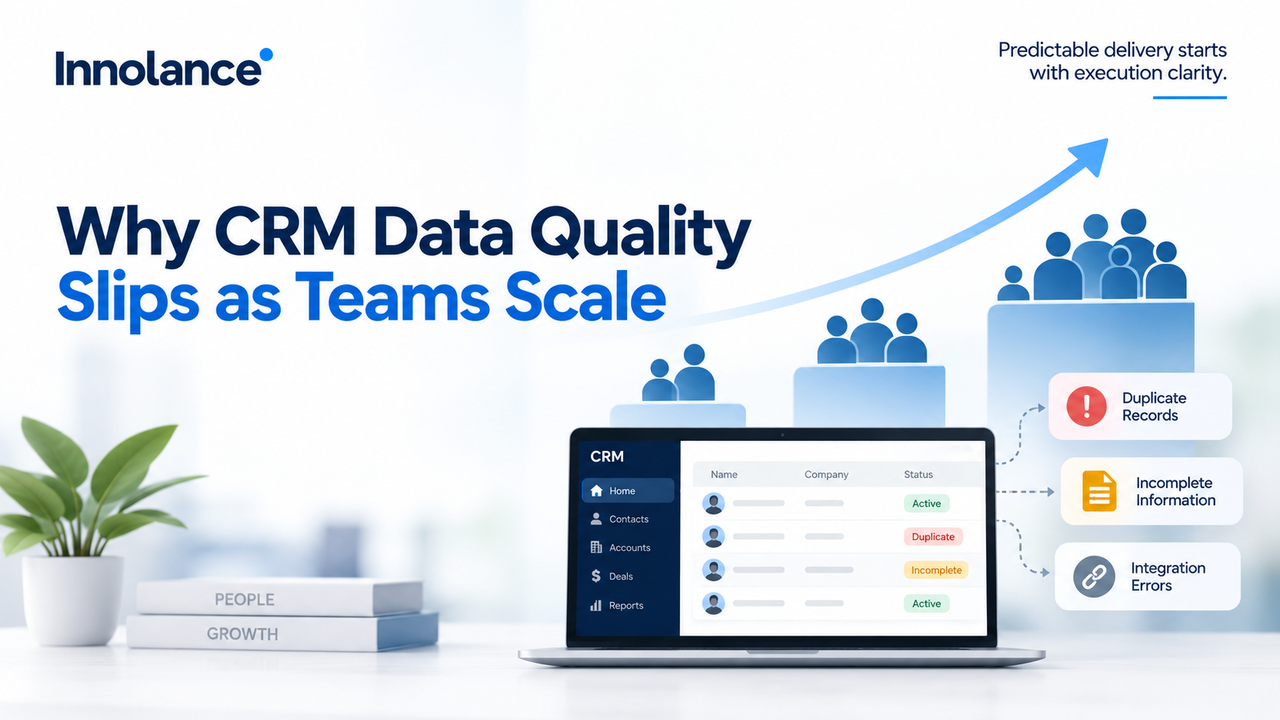
Learn why CRM data quality declines as teams scale and how stronger workflows, governance, and data standards can prevent errors during growth.
Executive Summary
CRM systems often work well when revenue teams are small. Fewer users, simpler workflows, and limited integrations make customer information easier to maintain. As organizations grow, however, more people, processes, systems, and records create opportunities for inconsistent or outdated data.
For revenue operations leaders and CRM administrators, protecting CRM data quality requires more than periodic database cleanup. The workflows, ownership rules, integrations, and data standards behind the CRM must scale with the organization.
Direct Answer: CRM data quality often declines during growth because increasing users, inconsistent data entry, duplicate records, unclear ownership, changing workflows, and disconnected integrations introduce errors faster than teams can correct them. Strong CRM data management addresses these operational causes before inaccurate data spreads across reporting and revenue workflows.
Why Does CRM Data Quality Decline During Growth?
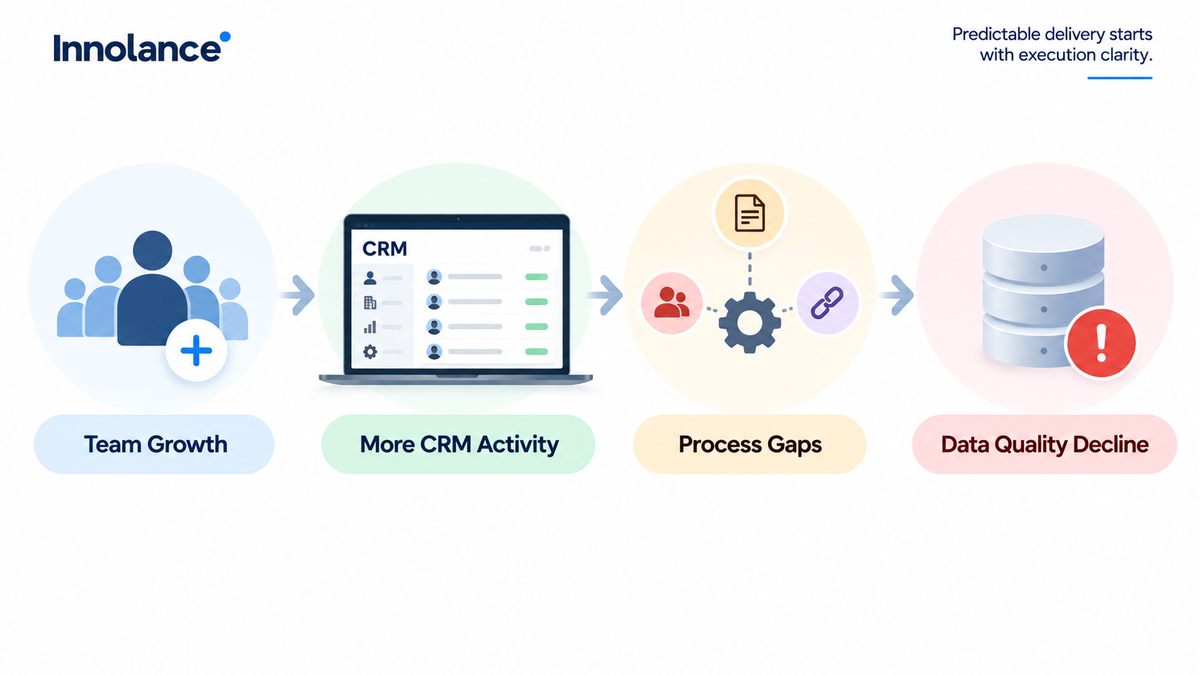
Growth increases both the volume and complexity of CRM activity.
More representatives create and update records. Marketing and sales teams introduce new fields. Additional systems exchange customer information with the CRM. Territories, lifecycle stages, routing rules, and ownership models also evolve.
Without consistent standards, each change can introduce differences in how customer data is captured and maintained. At scale, these differences can weaken customer data accuracy across the CRM.
Key Takeaway: CRM growth increases data complexity, making consistent processes increasingly important.
What Operational Breakdowns Create Poor CRM Data?
CRM data problems are often symptoms of process problems.
Common breakdowns include inconsistent data-entry practices, missing critical fields, unclear record ownership, duplicate contacts and companies, outdated lifecycle stages, conflicting field definitions, manual imports, and integration errors.
These issues can affect segmentation, lead routing, forecasting, reporting, automation, and customer communication.
Why Do Duplicate Records Increase as Teams Scale?
Duplicate records are a common challenge during rapid growth.
Sales representatives may create contacts that already exist. Marketing tools can sync records using different identifiers. Imports may introduce variations in company names or contact information.
Effective duplicate data prevention therefore requires more than occasional deduplication. Teams should define how records are created, establish matching rules, control imports, and determine which system is responsible for important customer information.
Fixing the creation process prevents teams from repeatedly cleaning the same problems.
How Do Inconsistent Workflows Affect Customer Data Accuracy?
A CRM field is only reliable when users understand when and how it should be updated.
Consider opportunity stages. If different representatives interpret stages differently, the CRM may contain technically complete records while still producing unreliable pipeline information.
The same problem can affect lifecycle stages, lead status, account ownership, close dates, and other important properties.
Strong CRM data management connects each critical field to a clear business definition and workflow. This makes data quality an operational responsibility rather than simply a database maintenance task.
How Do Integrations Create CRM Data Quality Problems?
As organizations scale, the CRM often connects with marketing automation, enrichment, sales engagement, customer success, billing, and analytics systems.
Each connection introduces another path through which information can change.
Problems occur when systems use different definitions, update the same field, or synchronize on different schedules. One platform may contain current information while another overwrites it with an older value.
For stronger CRM scalability, revenue operations teams should establish clear systems of record and ownership rules for important data.
How Can Leaders Recognize Data Quality Problems Early?
Waiting until dashboards become unreliable means data problems may already be widespread.
Revenue operations teams can monitor signals such as Duplicate Rate, Required Field Completion, Data Freshness, Record Ownership Coverage, Integration Errors, and Invalid Field Values.
Changes in these indicators can reveal where processes are beginning to break. For example, a sudden increase in incomplete records after expanding the sales team may point to onboarding or workflow design rather than a CRM technology problem.
How Can Teams Protect CRM Data Quality During Growth?
The strongest approach is preventative.
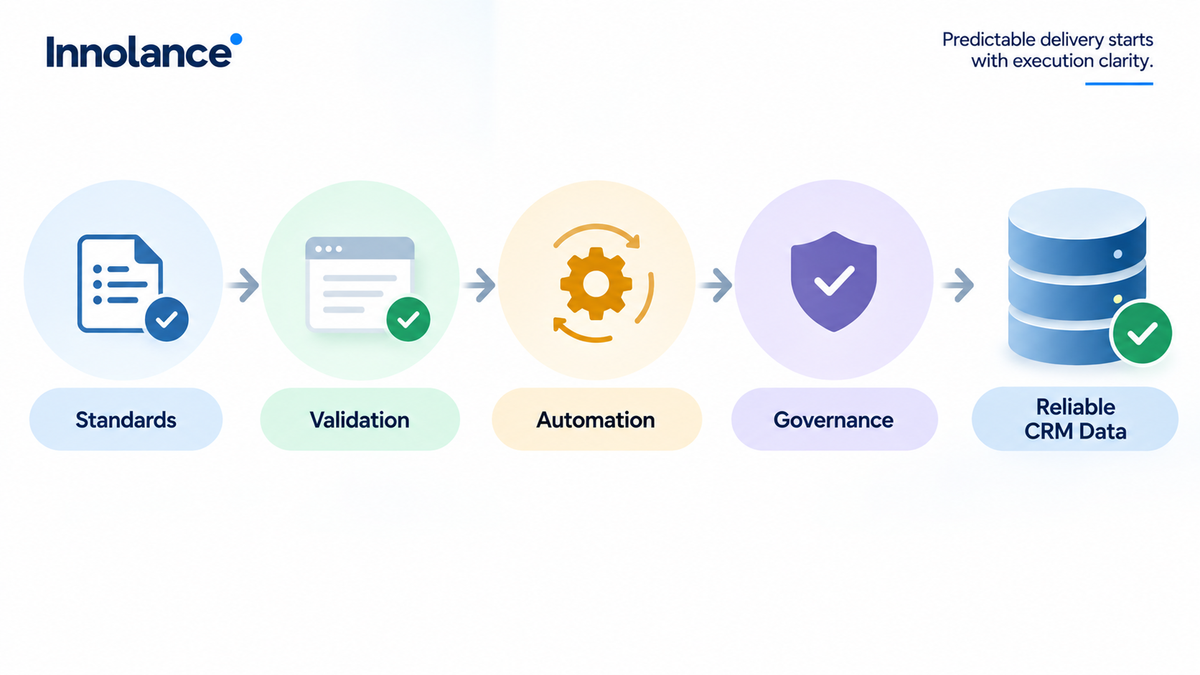
Define important CRM properties and ownership rules. Standardize how records enter the system. Validate critical information at appropriate workflow points. Automate repetitive updates where rules are clear, and regularly review integrations that modify customer data.
Governance should also evolve as teams grow. Revenue operations leaders need visibility into who owns important data, which systems can change it, and how exceptions are resolved.
Innolance approaches CRM optimization from this operational perspective connecting CRM configuration, workflow design, automation, and data visibility to help organizations create more dependable information as their revenue operations scale.
What Should Revenue Operations Leaders Do Next?
Start with one recurring CRM data problem rather than attempting to clean the entire database.
Trace where the inaccurate information originates, identify the process allowing it to occur, and correct that source.
Detect → Trace → Standardize → Automate → Monitor
Practical Tip: Fix the process creating unreliable CRM data before repeatedly cleaning its symptoms.
Conclusion
CRM data quality rarely declines because organizations simply have too much data. It declines when the processes governing that data fail to scale alongside the business.
As teams grow, consistent definitions, ownership, validation, automation, and integration governance become increasingly important.
By identifying operational breakdowns early and strengthening the processes behind CRM data quality, revenue operations leaders can improve customer data accuracy, reduce duplicate records, and build a more scalable foundation for reporting, automation, and revenue decisions.