
What Is a Self-Assessment Framework for Delivery? How Awareness Leads to Predictable Delivery
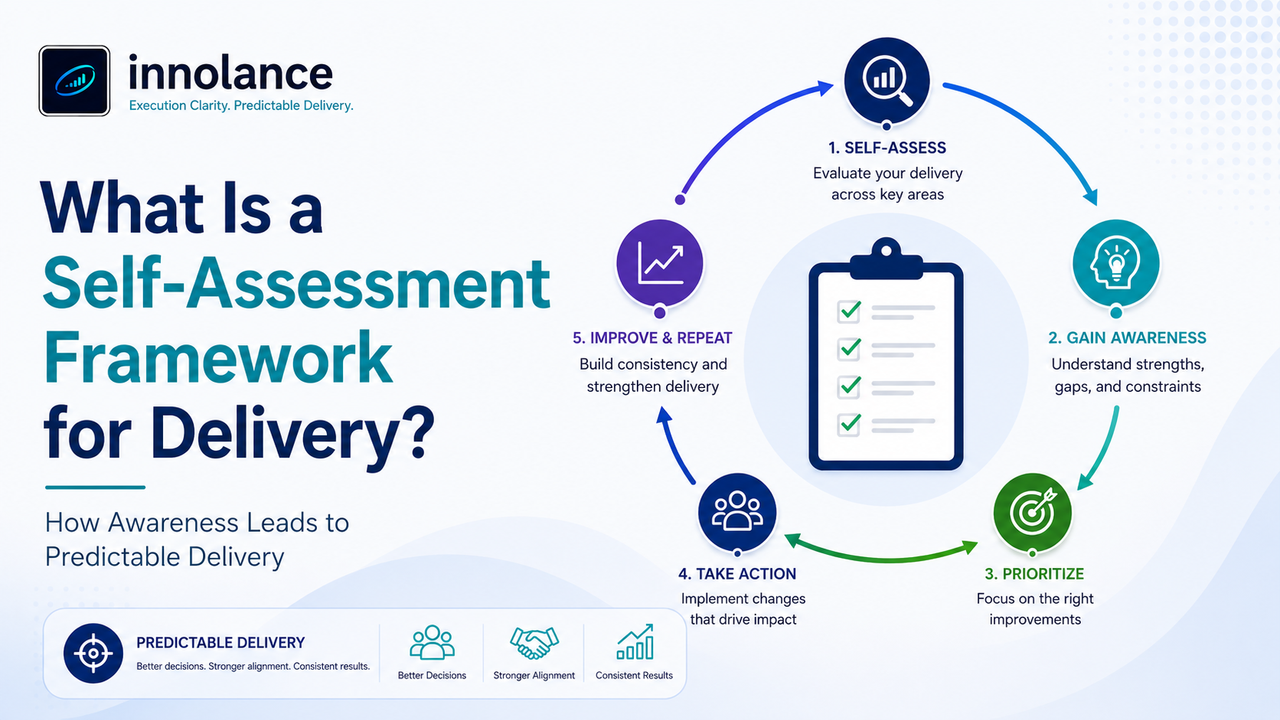
Learn how a delivery self-assessment framework creates organizational awareness, identifies execution gaps, and supports more predictable software delivery.
What Is a Self-Assessment Framework for Delivery?
Executive Summary
Software delivery becomes increasingly difficult as organizations grow. Teams expand, products become more complex, and dependencies multiply, making it harder to understand why delivery commitments become less predictable. A self-assessment framework helps organizations evaluate how planning, governance, collaboration, and execution work together, creating awareness of delivery maturity before problems become business risks. While self-assessment provides valuable internal insight, combining those findings with structured external guidance enables organizations to validate observations, identify root causes, and prioritize meaningful improvements that strengthen predictable delivery.
Direct Answer
A self-assessment framework for delivery is a structured approach that helps organizations evaluate delivery maturity across leadership, planning, governance, collaboration, and execution. Rather than measuring project outcomes alone, it helps leaders identify execution gaps, recognize delivery bottlenecks, and build organizational awareness that supports better decision-making and continuous improvement.
As organizations scale, software delivery becomes more complex. Teams grow, products evolve, and priorities compete for limited capacity. Delivery leaders may recognize symptoms such as delayed releases, shifting priorities, and missed commitments, but identifying the underlying causes is much harder. Traditional project dashboards show what is happening, but they rarely explain why delivery confidence is declining.
Before introducing new processes, restructuring teams, or investing in large transformation initiatives, organizations need a clear understanding of how delivery operates today. A self-assessment framework provides that starting point by helping leadership teams evaluate planning, governance, collaboration, and execution across the organization.
Execution Clarity the ability to understand where execution is breaking down and why helps leaders identify bottlenecks earlier, strengthen alignment, and make informed decisions before delivery is impacted. Self-assessment creates valuable organizational awareness, while structured validation helps organizations understand root causes and act on the right priorities.
What Does a Self-Assessment Framework Help Organizations Understand?
Many delivery challenges develop gradually. Teams remain productive, projects continue moving forward, and regular status meetings suggest that work is progressing as expected. Beneath the surface, however, planning assumptions change, cross-functional dependencies increase, communication slows, and decision-making becomes more complex. These issues often remain unnoticed until delivery schedules begin slipping.
A structured self-assessment framework gives leadership teams the opportunity to step back and evaluate how delivery operates across the organization. Instead of focusing only on project outcomes, it encourages leaders to assess planning practices, execution flow, governance, collaboration, and delivery consistency. The goal is not to identify immediate solutions but to build a shared understanding of the organization's current delivery maturity.
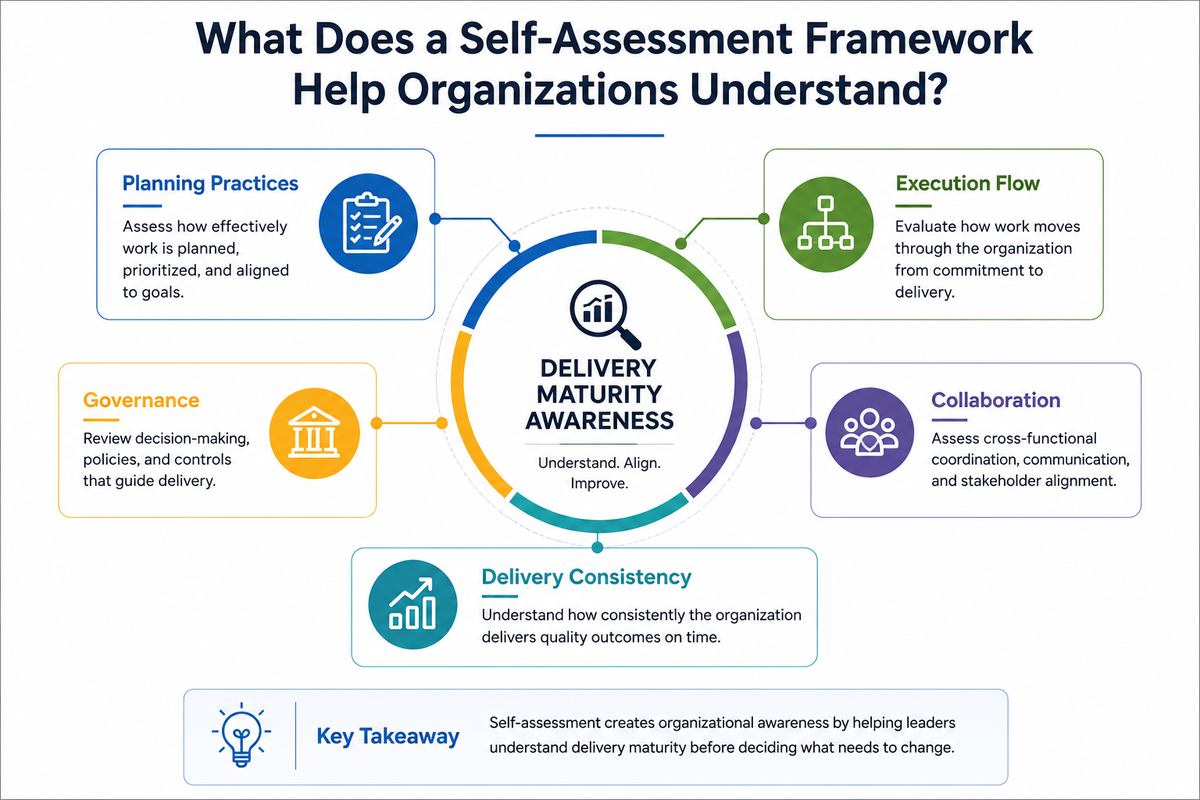
Key Takeaway: Self-assessment helps organizations understand how delivery is performing before deciding what needs to change.
How Can Organizations Recognize Delivery Bottlenecks Before They Affect Business Outcomes?
Delivery bottlenecks rarely appear overnight. Capacity constraints, planning gaps, competing priorities, and cross-team dependencies often accumulate gradually before affecting delivery performance. By the time release schedules begin slipping or customer commitments are impacted, these constraints have usually existed for weeks or months.
A self-assessment framework helps leaders recognize these patterns by looking beyond project status reports and examining how work flows throughout the organization. Rather than measuring completed work alone, it encourages discussions around planning effectiveness, communication, ownership, governance, and execution.
Early visibility enables organizations to investigate potential constraints before they become significant business risks, allowing improvement efforts to be proactive rather than reactive.
Key Takeaway: Early awareness of delivery bottlenecks enables organizations to make proactive improvement decisions before missed commitments affect customers and business outcomes.
Why Is Understanding Delivery Maturity Important?
Every organization has different strengths and challenges. Some teams have effective planning practices but struggle with cross-functional coordination. Others have strong technical execution but lack visibility into delivery performance or decision-making. Without understanding current delivery maturity, improvement efforts often focus on isolated symptoms instead of addressing the underlying issues.
A self-assessment framework provides a structured way to evaluate delivery maturity across leadership, planning, governance, collaboration, and execution. These insights help leadership teams understand where they are today and where improvement efforts are likely to have the greatest impact. Rather than introducing broad organizational changes, leaders can prioritize improvements that strengthen delivery capability and support sustainable growth.
Key Takeaway: Understanding delivery maturity helps organizations focus improvement efforts where they will create the greatest business value.
How Does Execution Clarity Turn Awareness into Action?
While self-assessment creates valuable organizational awareness, it is only the first step toward improving delivery performance. Internal assessments help leaders recognize where challenges may exist, but they do not always reveal the underlying causes or provide a clear roadmap for improvement.
This is where structured external guidance provides additional value. An independent assessment validates internal observations, uncovers execution gaps that may not be visible internally, and helps leadership teams prioritize improvement opportunities based on business outcomes rather than assumptions.
At Innolance, organizations use Execution Clarity to move beyond awareness. Through structured assessments such as ExecLens™, leadership teams gain deeper visibility into planning effectiveness, execution flow, organizational alignment, and overall delivery health. Rather than replacing internal self-assessment, this approach builds on it by providing the insights needed to make confident, evidence-based improvement decisions.
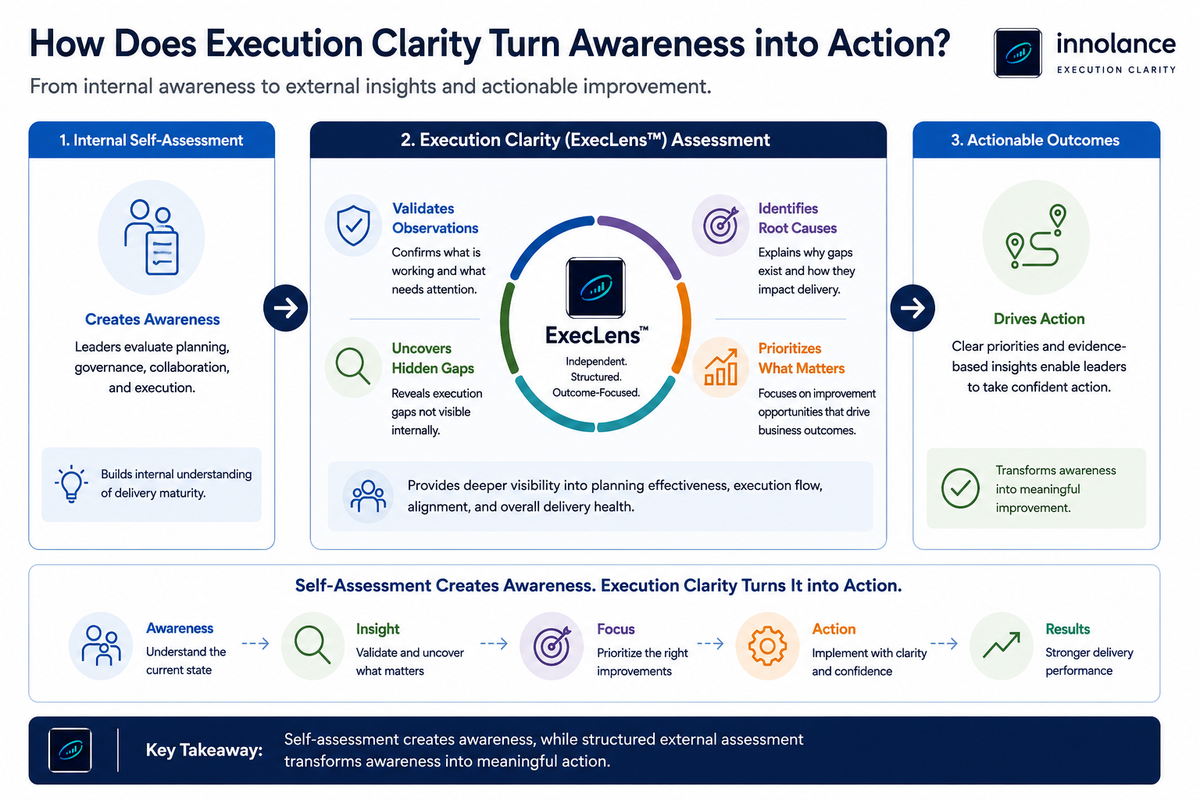
Key Takeaway: Self-assessment creates awareness, while structured external assessment transforms awareness into meaningful action.
How Can Organizations Build More Predictable Delivery?
Once organizations have a clear understanding of their delivery environment, they can begin strengthening the systems that support execution. This includes improving planning practices, enhancing cross-functional collaboration, reducing execution bottlenecks, and increasing visibility into delivery performance.
At Innolance, these improvements are guided through the Predictable Delivery Program (PDP). Using the insights generated through ExecLens™, organizations develop practical improvement priorities that strengthen delivery capability over time. Rather than introducing unnecessary complexity, the focus remains on improving execution where it matters most and creating sustainable delivery practices that continue to support organizational growth.
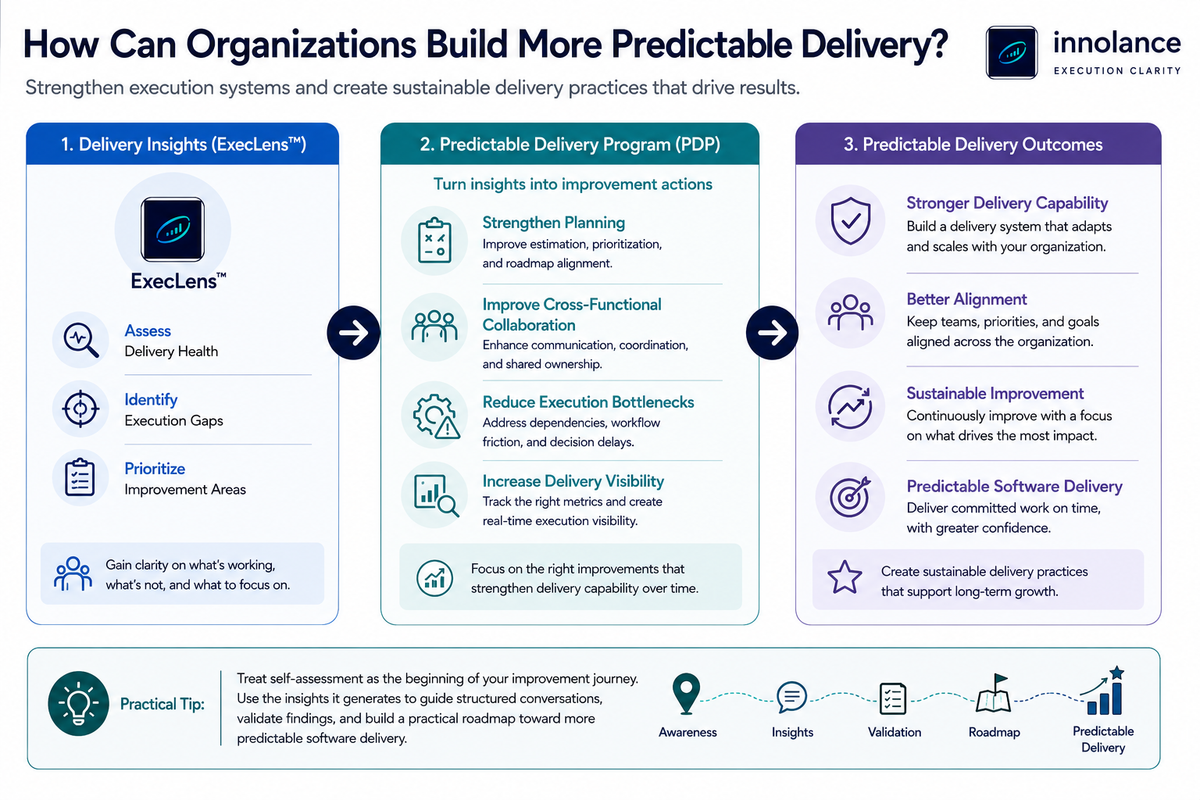
Practical Tip: Treat self-assessment as the beginning of your improvement journey. Use the insights it generates to guide structured conversations, validate findings, and build a practical roadmap toward more predictable software delivery.
Conclusion
A self-assessment framework helps organizations understand how planning, governance, collaboration, and execution influence delivery performance. It creates the organizational awareness needed to recognize delivery gaps before they become larger business risks.
However, awareness alone does not create improvement. Organizations must validate their findings, identify root causes, and prioritize the changes that will have the greatest impact. Through Execution Clarity, ExecLens™, and the Predictable Delivery Program, Innolance helps leadership teams turn assessment insights into practical actions that strengthen delivery capability and support more predictable software delivery.