
Understanding Delivery Constraints in Software Teams

Learn how software leaders can identify delivery constraints across strategy, planning, dependencies, decisions, and engineering workflows before delays escalate.
Executive Summary
Software delivery constraints rarely appear as one obvious bottleneck. They often develop across strategy, portfolio planning, dependencies, capacity, decision-making, and engineering workflows. A team may appear productive while constraints elsewhere in the organization make delivery increasingly unpredictable.
For CTOs, CIOs, COOs, and software delivery leaders, effective delivery constraint identification requires looking beyond isolated delays and examining observable execution signals across the entire delivery system.
Direct Answer: Delivery constraints are conditions that limit how reliably work moves from strategic priorities through planning and engineering execution. Leaders can identify them by monitoring signals such as unstable priorities, excessive work in progress, dependency delays, decision latency, capacity imbalance, and inconsistent commitments.
What Are Delivery Constraints in Software Teams?
A delivery constraint is any condition that restricts the flow, speed, or reliability of software delivery.
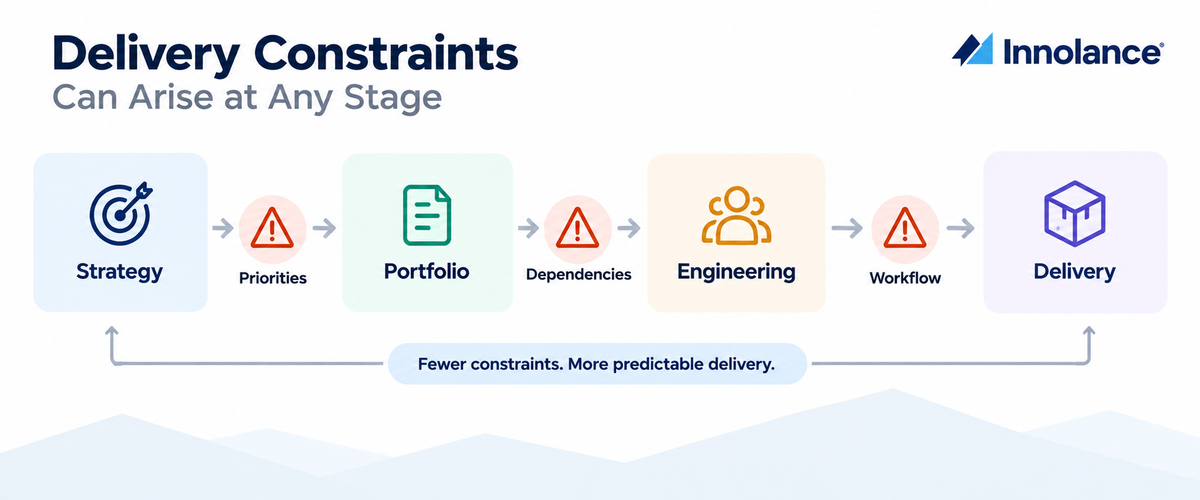
Constraints can exist at multiple organizational levels. Leadership may create competing priorities. Portfolio planning may introduce more work than teams can absorb. Engineering workflows may accumulate work in review, testing, security, or deployment.
This is why leaders should avoid assuming that every missed milestone represents an engineering problem.
Key Takeaway: The visible bottleneck may be where a problem appears not where the underlying constraint originates.
Why Are Delivery Constraints Difficult to Identify?
Traditional reporting often emphasizes milestones, sprint completion, utilization, or roadmap status. These measures describe progress but may not explain why delivery performance is changing.
A roadmap can remain green while dependencies accumulate. Engineering teams can stay busy while work waits for decisions. Individual teams can meet sprint goals while portfolio commitments continue to exceed available capacity.
Effective organizational delivery management therefore requires visibility into how work behaves across organizational boundaries.
Which Signals Reveal Delivery Constraints?
Leaders should look for recurring patterns rather than isolated incidents.
Common signals include:
- Increasing cycle or lead time
- Growing work in progress
- Frequent priority changes
- Repeated carryover between iterations
- Unresolved cross-team dependencies
- Long approval or decision queues
- Declining commitment reliability
When several signals appear together, they can reveal delivery bottlenecks before a major milestone slips.
Where Do Delivery Constraints Usually Occur?
1. Strategy and Priority Constraints
When priorities change faster than teams can execute them, commitments become unstable. Teams repeatedly stop, restart, or redirect work, increasing delivery uncertainty.
2. Portfolio and Capacity Constraints
Portfolio plans can exceed available capacity. Too many simultaneous initiatives increase work in progress, dependencies, and coordination overhead.
3. Dependency Constraints
Modern software delivery crosses product, engineering, security, infrastructure, operations, and external partners. Unmanaged dependencies introduce waiting time and uncertainty.
4. Decision Constraints
Work can stall when ownership is unclear or critical decisions require lengthy escalation. Decision latency becomes a constraint even when engineering capacity is available.
5. Workflow Constraints
Code review, testing, security approval, or deployment can become constrained when work enters these stages faster than it leaves.
How Should Leaders Identify the Real Constraint?
Effective service delivery analysis compares where work should move with where it actually waits.
Leaders should ask:
- Where does work consistently wait?
- Which priorities repeatedly change?
- Which dependencies affect multiple releases?
- Where is work in progress increasing?
- Which decisions repeatedly delay execution?
- Which constraint has the greatest system-wide impact?
These questions help distinguish symptoms from systemic constraints.
How Does Execution Clarity Make Constraints Visible?
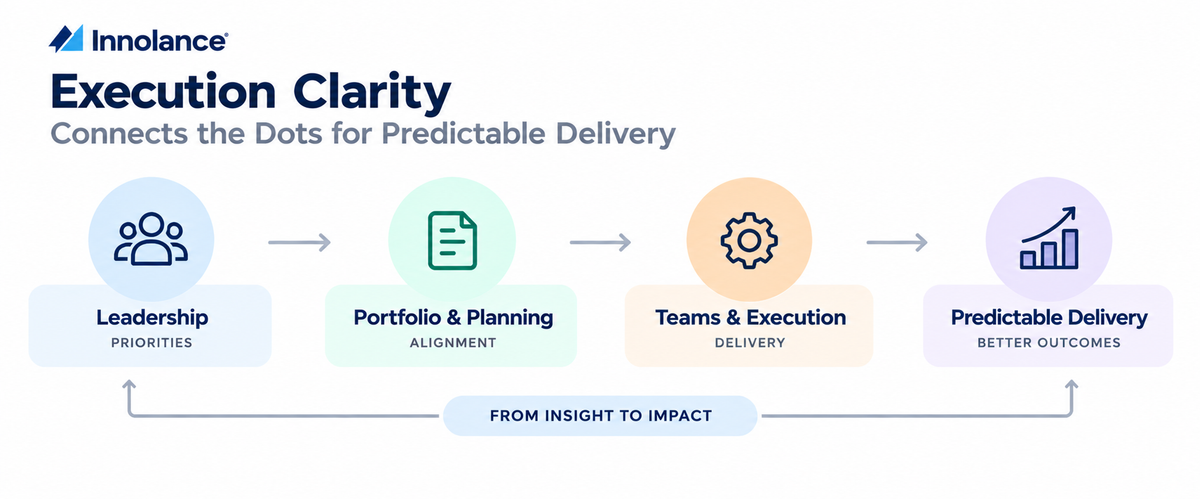
Execution Clarity the ability to understand where execution is breaking down and why helps leaders identify constraints earlier, strengthen alignment, and make informed decisions before delivery is impacted.
It connects signals across leadership priorities, portfolio planning, and team execution, helping leaders understand whether problems originate in strategy, capacity, dependencies, decisions, or engineering workflows.
What Should Leaders Do Next?
Do not begin by adding more process to whichever team appears slowest.
Start by identifying where work repeatedly waits, commitments change, dependencies remain unresolved, and decisions slow execution. Then determine which constraint has the greatest impact on the overall delivery system.
Predictable delivery starts with Execution Clarity.
Conclusion
Delivery constraints are rarely confined to engineering. They can originate in strategy, portfolio planning, capacity, dependencies, decisions, or workflow design.
By using observable execution signals instead of focusing only on isolated bottlenecks, leaders can strengthen delivery constraint identification, address systemic constraints, and create more predictable software delivery.