The Complete Guide to Cross-Team Dependencies
Learn why cross-team dependencies slow software delivery and how leaders can identify, prioritize, and reduce them for more predictable execution.
Executive Summary
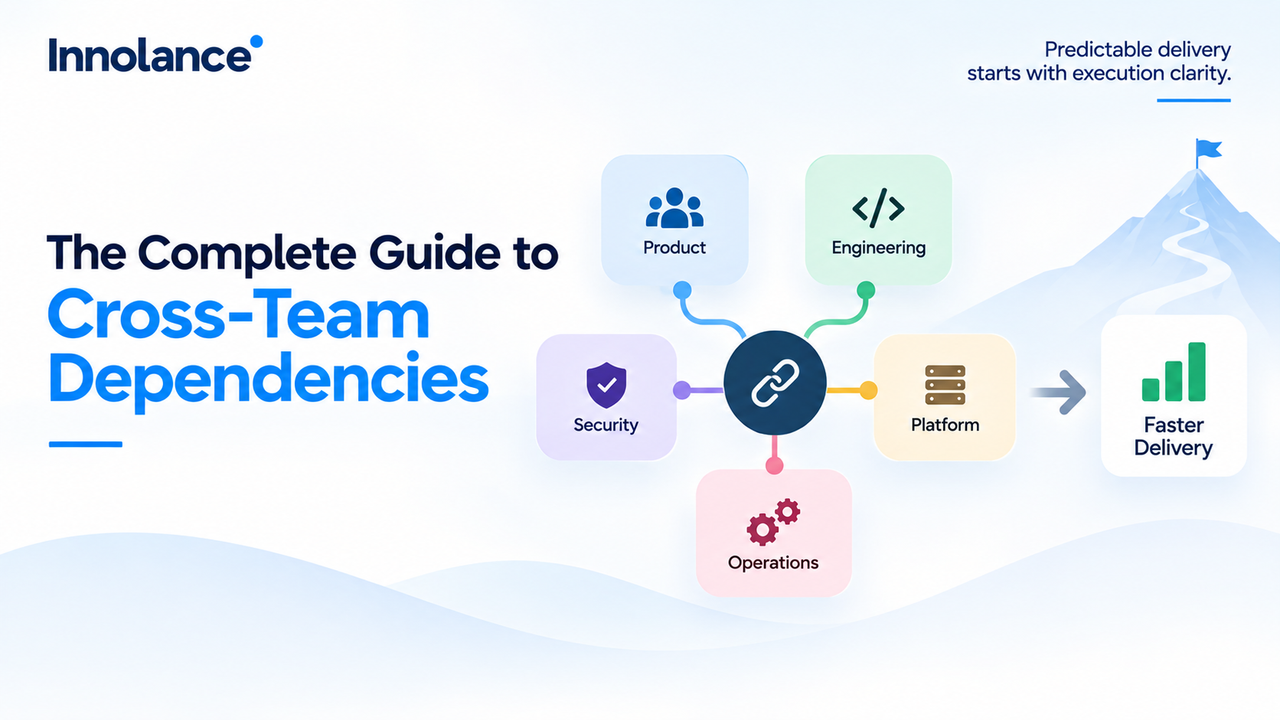
Software delivery rarely happens within a single team. As organizations grow, engineering, product, platform, security, data, infrastructure, and operations teams increasingly depend on one another to deliver customer outcomes.
These cross-team dependencies become a major source of delivery delays when ownership is unclear, sequencing is poorly coordinated, or dependencies are discovered too late. For CTOs, VP Engineering, and product leaders, improving delivery requires visibility not only into individual teams but also into how work moves between them.
Direct Answer: Cross-team dependencies slow software delivery because one team’s progress becomes dependent on another team’s capacity, priorities, decisions, or deliverables. Leaders can reduce this risk by identifying dependencies during planning, clarifying ownership, prioritizing high-impact constraints, and monitoring dependencies throughout execution.
What Are Cross-Team Dependencies?
A cross-team dependency exists when one team cannot complete or progress its work without input, decisions, services, or deliverables from another team.
For example, a product team may need an API from a platform team before completing a feature. Engineering may need security approval before deployment. A frontend team may depend on backend changes before integration can begin.
Dependencies are not inherently a problem. The risk appears when they are invisible, unmanaged, or poorly synchronized.
Key Takeaway: Dependencies become delivery risks when teams cannot clearly see, coordinate, or manage them.
Why Do Cross-Team Dependencies Slow Delivery?
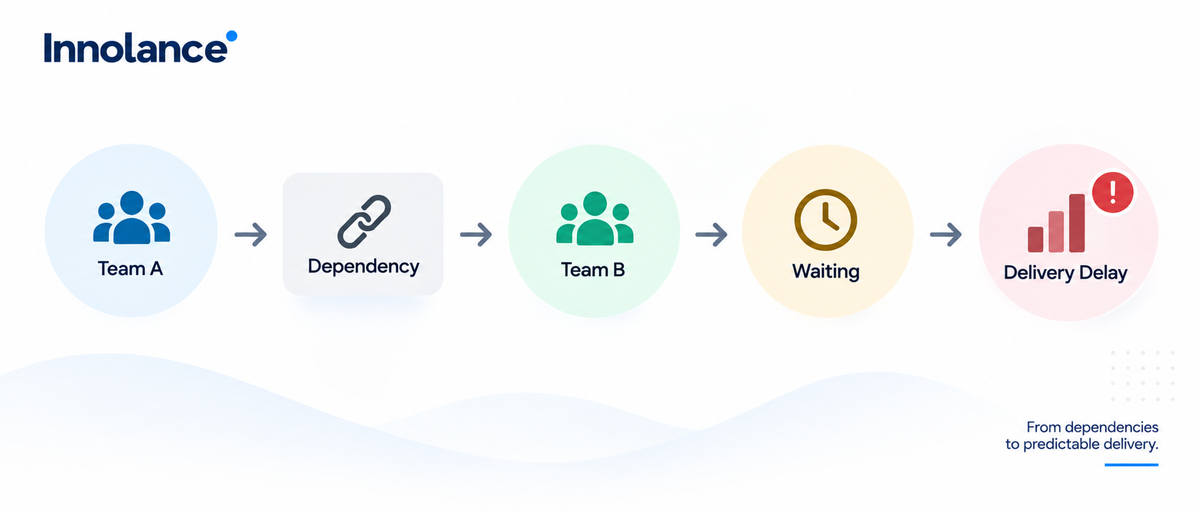
Dependencies introduce waiting into workflows.
A team may be ready to continue but cannot move because another team has different priorities, limited capacity, or an unresolved decision. Even when each team performs well independently, the overall delivery system can slow down.
This creates workflow bottlenecks that may not appear in individual team metrics. One team’s work looks complete while another team waits for the output required to continue.
As organizations scale, these waiting points can multiply across initiatives.
Why Are Dependencies Often Discovered Too Late?
Many organizational dependencies remain hidden during early planning because teams focus primarily on their own work.
Dependencies may only become visible when implementation begins and teams discover that they need another service, approval, technical component, or decision.
Late discovery creates unplanned coordination and forces teams to adjust sequencing after commitments have already been made.
Effective agile portfolio planning should therefore identify important dependencies before work reaches active execution.
How Do Dependencies Affect Agile Portfolio Planning?
Portfolio plans often connect multiple teams to the same strategic initiative.
If leaders plan each team’s commitments independently, they may miss the relationships between those commitments. A platform capability scheduled for later in the quarter, for example, could block a product feature expected earlier.
Strong project management and portfolio planning should make these relationships visible.
Leaders need to understand which initiatives depend on shared teams, where sequencing matters, and whether supporting teams have enough capacity to meet expected timelines.
This creates a more realistic view of delivery risk before commitments are finalized.
How Can Leaders Identify High-Risk Dependencies?
Not every dependency requires the same level of attention.
Leaders should focus on dependencies that affect critical milestones, involve multiple teams, rely on constrained resources, have unclear ownership, or create significant downstream waiting.
Useful questions include: Which team owns the dependency? When is it needed? Is capacity available? What work becomes blocked if it is delayed? How quickly can decisions or escalations occur?
Execution Clarity the ability to understand where execution is breaking down and why helps leaders connect these dependency signals across leadership, portfolio planning, and team execution.
How Can Teams Reduce Cross-Team Dependencies?
The goal is not necessarily to eliminate every dependency. Growing software organizations will naturally have shared platforms, specialized capabilities, and coordinated initiatives.
Instead, leaders should reduce unnecessary dependencies and manage essential ones deliberately.
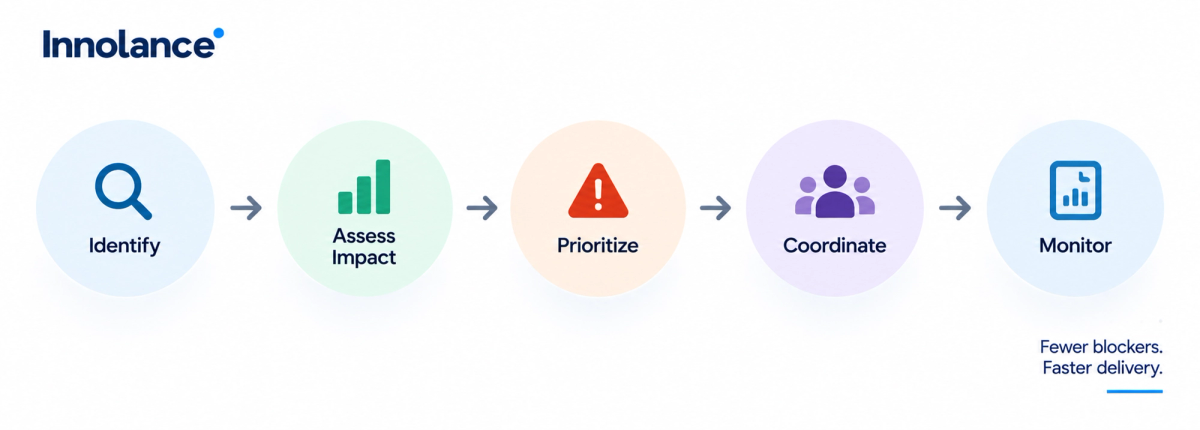
Teams can simplify ownership boundaries, expose dependencies earlier, align sequencing during planning, reserve capacity for shared work, and establish clear escalation paths when commitments are at risk.
Where dependencies repeatedly create delivery delays, leaders should investigate the operating model itself rather than treating every delay as an isolated coordination problem.
What Should Leaders Monitor?
Dependency management should continue after planning.
Leaders can monitor Dependency Age, Blocked Work, Waiting Time, Dependency Completion Reliability, Cross-Team Handoffs, and Decision Delays.
Patterns across these signals can reveal structural constraints. For example, repeated delays involving the same shared team may indicate a capacity or prioritization issue rather than poor coordination by individual delivery teams.
Practical Tip: Track where work waits between teams, not only how quickly work moves within each team.
What Should Leaders Do Next?
Start with one important initiative involving multiple teams.
Map the dependencies required for delivery, identify owners and expected completion points, and determine which dependencies could block downstream work.
A practical sequence is:
Map → Prioritize → Coordinate → Monitor → Improve
Innolance approaches dependency management through Execution Clarity, helping organizations examine how leadership decisions, portfolio commitments, and team execution interact so systemic constraints become visible before they disrupt predictable delivery.
Conclusion
Cross-team dependencies are a natural part of modern software delivery, but unmanaged dependencies can turn coordination into waiting, rework, and missed commitments.
For growing software companies, improving team coordination requires visibility across organizational boundaries. Leaders need to understand where teams depend on one another, which dependencies create the greatest delivery risk, and whether priorities and capacity support the planned sequence of work.
By identifying dependencies earlier, prioritizing their impact, and monitoring them throughout execution, organizations can reduce workflow bottlenecks and create a stronger foundation for predictable software delivery.