
The Complete Guide to CRM Adoption After Go Live

Learn why CRM adoption drops after go-live and how better workflow design, training, change management, and governance can make CRM usage stick.
Executive Summary
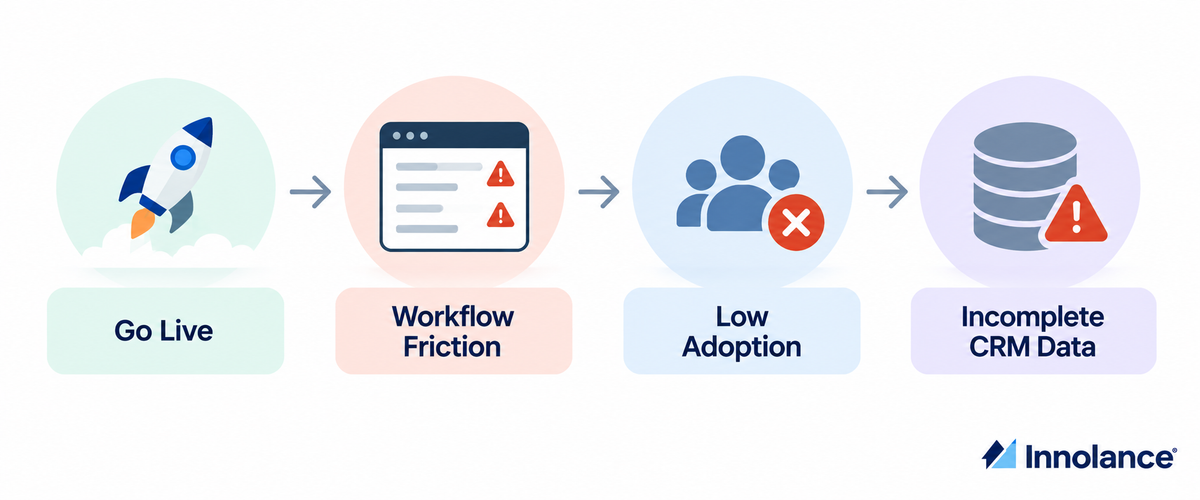
A successful CRM launch does not guarantee long-term adoption. Many organizations complete a HubSpot or Salesforce implementation only to see usage decline once the initial rollout ends.
The problem is rarely the technology alone. Low CRM adoption often develops when workflows create unnecessary effort, users do not understand how the CRM supports their work, training stops at go-live, or governance fails to reinforce consistent usage.
Direct Answer: CRM adoption often drops after implementation because users encounter workflow friction, insufficient training, unclear expectations, inconsistent data, and limited post-launch governance. Organizations can improve adoption by simplifying workflows, providing role-based training, reinforcing expectations through change management, and continuously addressing usage barriers.
Why Does CRM Adoption Drop After Go Live?
During implementation, CRM projects receive significant attention. Teams configure fields, migrate data, build workflows, test integrations, and prepare users for launch.
After go-live, attention often shifts elsewhere. Users then encounter real-world problems that were less visible during implementation: unnecessary fields, duplicate data entry, confusing stages, unclear ownership, or processes that do not match daily work.
These CRM implementation challenges can gradually become adoption problems.
Key Takeaway: CRM adoption is not achieved at launch. It develops through the everyday experience users have with the system.
1. CRM Workflows Create Too Much Friction
One of the biggest CRM usage barriers is unnecessary effort.
If sales representatives must update numerous fields, duplicate information across systems, or complete steps that provide little immediate value, the CRM begins to feel like administrative work.
Users may respond by entering incomplete information, delaying updates, or maintaining separate spreadsheets and notes.
Improve it: Remove unnecessary workflow steps and automate repeatable updates where rules are clear.
2. Training Stops at Implementation
Initial CRM training often focuses on platform navigation rather than how employees should use the CRM within their daily workflows.
Users may know how to create an opportunity but remain unclear about when stages should change, which information is required, or how their updates affect downstream teams.
Improve it: Provide ongoing, role-specific training based on real workflows rather than one-time platform demonstrations.
4. Change Management Ends Too Early
CRM implementation changes responsibilities and workflows not simply software.
Effective change management should continue after launch. Leaders need to reinforce expectations, explain why processes matter, collect feedback, and address recurring friction.
Without reinforcement, teams can gradually return to previous habits.
Improve it: Establish regular post-launch feedback cycles and make process owners accountable for addressing recurring adoption barriers.
5. Governance Does Not Keep Pace With Change
CRM environments continuously evolve as organizations add employees, territories, products, fields, integrations, and automation.
Without governance, duplicate fields can appear, workflows conflict, definitions become inconsistent, and users lose confidence in CRM data.
Improve it: Establish clear ownership for CRM standards, workflow changes, data quality, documentation, and periodic system reviews.
How Should Leaders Measure CRM Adoption?
Login frequency alone does not demonstrate meaningful adoption.
Leaders should examine whether users consistently perform the activities required for reliable revenue execution.
Useful indicators include:
- Required-field completion
- Opportunity-stage accuracy
- Activity capture
- Data freshness
- Workflow exception rates
- Lead and opportunity ownership
These signals help distinguish occasional CRM access from genuine process adoption.
How Does Execution Clarity Improve CRM Adoption?
Execution Clarity the ability to understand where execution is breaking down and why helps leaders identify whether adoption problems originate from workflow design, training, governance, user behavior, or CRM configuration.
Instead of assuming every adoption problem requires more training, leaders can examine how people, processes, and technology interact across daily revenue operations.
How Does Execution Clarity Improve CRM Adoption?
Execution Clarity the ability to understand where execution is breaking down and why helps leaders identify whether adoption problems originate from workflow design, training, governance, user behavior, or CRM configuration.
Instead of assuming every adoption problem requires more training, leaders can examine how people, processes, and technology interact across daily revenue operations.
What Should Leaders Do After Go Live?
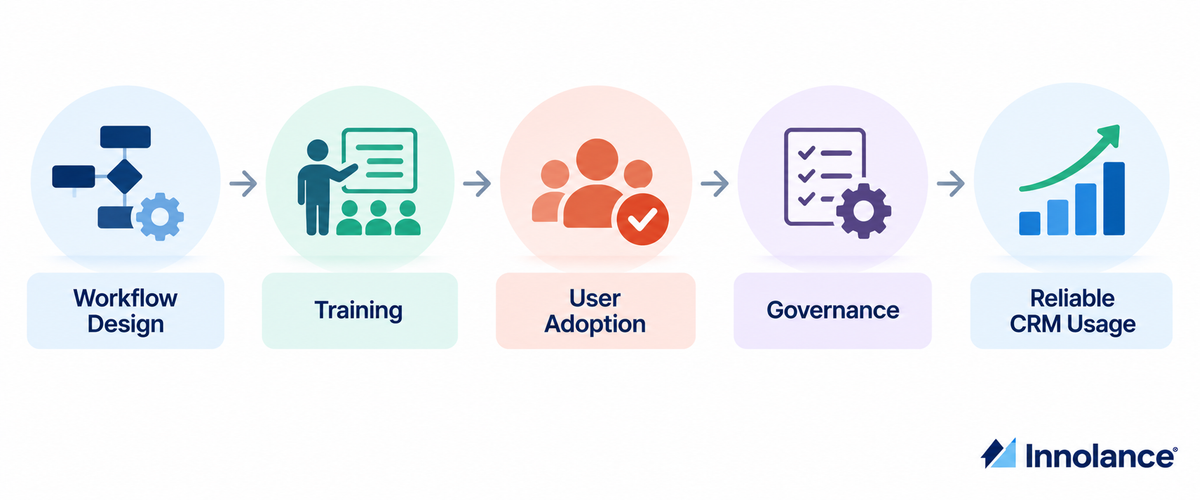
Start by identifying where users experience friction rather than immediately adding more training.
Review workflows, examine recurring data gaps, gather user feedback, and determine whether expectations and ownership are clear. Then simplify processes, reinforce training, and establish governance for continuous improvement.
Successful CRM implementation does not end at go-live. Sustainable adoption begins there.
Conclusion
Low CRM adoption is rarely caused by user resistance alone. It develops when workflow friction, insufficient training, unclear value, weak change management, and inconsistent governance make CRM usage difficult to sustain.
By addressing these conditions together, B2B organizations can strengthen CRM adoption, improve data reliability, and turn HubSpot or Salesforce into a system teams consistently use to support revenue execution.