
How to Prioritize Execution Bottlenecks in 2026

Learn how to identify, rank, and fix execution bottlenecks using workflow evidence to improve operational efficiency and predictable delivery.
Executive Summary
Execution bottlenecks rarely appear as one obvious failure. They develop when work repeatedly waits for decisions, dependencies remain unresolved, priorities compete, or workflows accumulate more work than they can process.
For CTOs, CIOs, COOs, and product and operations leaders, effective execution bottleneck analysis requires more than identifying where work looks slow. Leaders need practical workflow evidence to determine which constraint affects the broader execution system and which bottleneck should be addressed first.
Direct Answer: The best way to uncover and prioritize execution bottlenecks is to identify where work repeatedly waits, analyze the underlying cause, measure its impact on strategic commitments, and rank constraints by their effect on overall execution flow.
Step 1: Where Is Work Consistently Waiting?
Start with observable workflow evidence.
Look for areas where work repeatedly accumulates, changes direction, or remains blocked. Useful signals include:
- Increasing cycle or lead time
- Growing work in progress
- Repeated carryover
- Unresolved dependencies
- Long approval queues
- Delayed decisions
- Declining commitment reliability
These patterns provide a stronger foundation for process bottleneck identification than assumptions about which team appears slowest.
Key Takeaway: Start with where work waits, not where leaders assume the problem exists.
Step 2: What Is Actually Creating the Bottleneck?
The visible slowdown may only be a symptom.
For example, engineering work waiting for approval might appear to be an engineering bottleneck. Further analysis could reveal unclear decision ownership. A testing queue might actually originate from excessive work in progress or recurring quality problems upstream.
Leaders should ask:
- What causes work to enter this queue?
- How long does work typically wait?
- Which teams or decisions are involved?
- Does the problem recur across initiatives?
- What happens elsewhere when this work is delayed?
This moves performance analysis from identifying symptoms to diagnosing causes.
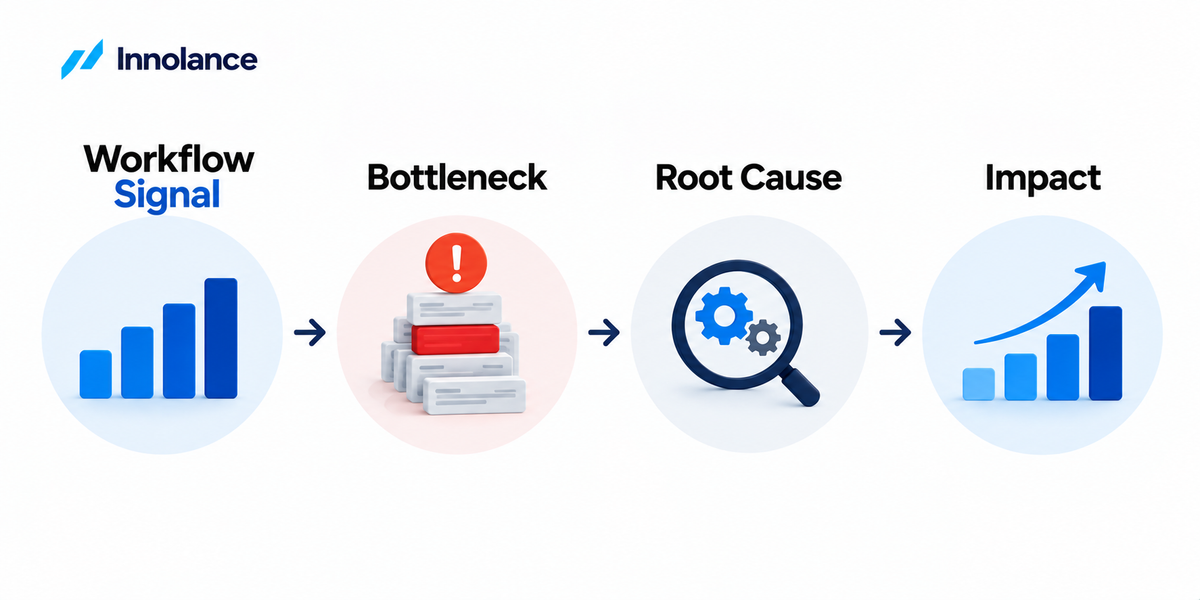
Step 3: How Should Leaders Rank Execution Bottlenecks?
Not every bottleneck deserves equal attention.
A useful prioritization method considers three factors:
Impact: How strongly does the constraint affect strategic commitments or delivery outcomes?
Frequency: How often does the constraint interrupt execution?
Reach: How many teams, initiatives, or dependencies are affected?
A recurring decision delay affecting several strategic initiatives should generally receive higher priority than a localized workflow issue affecting one team.
This helps leaders direct process improvement toward constraints with the greatest organizational impact.
Step 4: Which Bottleneck Should Be Fixed First?
Prioritising the constraint that most limits overall execution flow not necessarily the easiest problem to solve.
Corrective actions may include clarifying decision ownership, reducing work in progress, resolving critical dependencies, adjusting capacity, simplifying approvals, or changing workflow policies.
Effective workflow optimization focuses resources on the constraint whose removal is most likely to improve the broader system.
Practical Tip: Avoid optimizing every workflow simultaneously. Fix the highest-impact constraint, observe the result, and then reassess.
Step 5: How Do Leaders Know Whether the Fix Worked?
Measure the same execution signals that revealed the bottleneck.
If decision latency was the constraint, decision wait time should decline. If excessive work in progress was slowing flow, cycle time and queue size should improve. If dependencies were responsible, blocked work and commitment reliability should show measurable change.
A simple improvement cycle is:
Identify → Prioritize → Fix → Validate
This creates evidence-based continuous improvement rather than one-time process changes.
How Does Execution Clarity Improve Bottleneck Prioritization?
Execution Clarity the ability to understand where execution is breaking down and why helps leaders connect workflow evidence with the organizational conditions creating bottlenecks.
It brings together visibility across leadership priorities, portfolio planning, and team execution, helping leaders distinguish localized friction from constraints that affect strategic delivery.
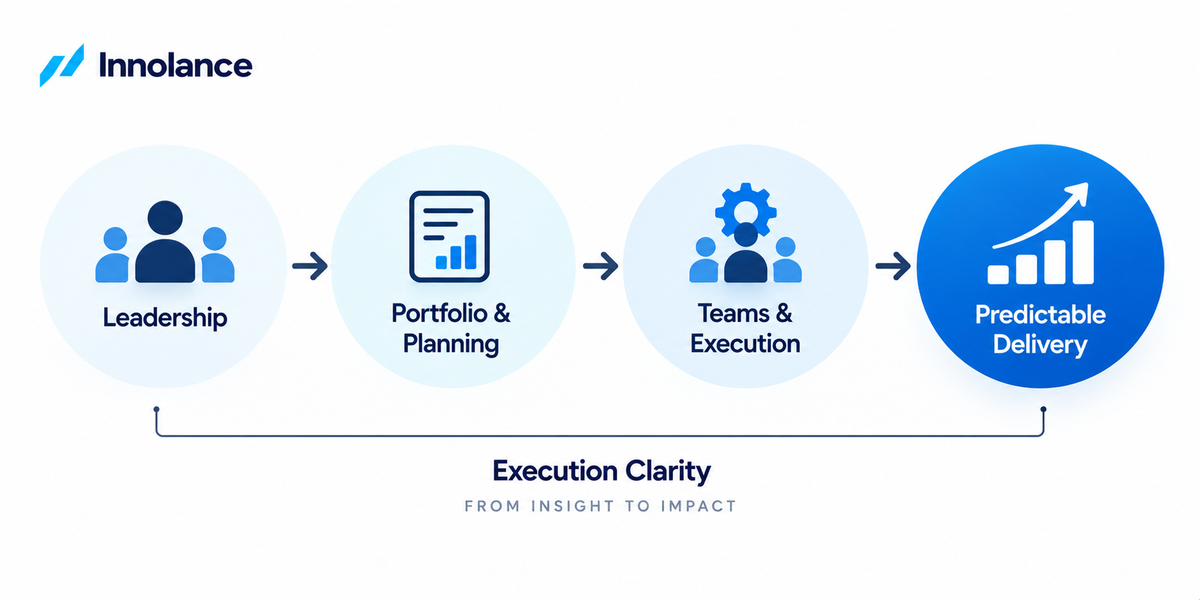
Innolance approaches execution bottleneck analysis from this organizational perspective, helping leaders identify where execution is constrained and prioritize improvements based on system-wide impact rather than isolated symptoms.
What Should Leaders Do Next?
Begin with one recurring execution problem.
Identify where work consistently waits, diagnose why it happens, and evaluate the constraint based on impact, frequency, and reach. Address the highest-priority bottleneck and then measure whether execution improves.
The process is straightforward:
Observe → Diagnose → Prioritize → Improve
The discipline of repeating it creates stronger operational efficiency over time.
Predictable delivery starts with Execution Clarity.
Conclusion
Execution bottlenecks become costly when organizations address symptoms without understanding which constraints have the greatest impact.
By combining workflow evidence with structured execution bottleneck analysis, leaders can identify root causes, rank constraints, focus improvement efforts, and make strategic decisions faster.
The goal is not to eliminate every point of friction. It is to continuously identify and address the constraints that matter most to predictable execution.