
How to Diagnose Leadership Execution Blind Spots
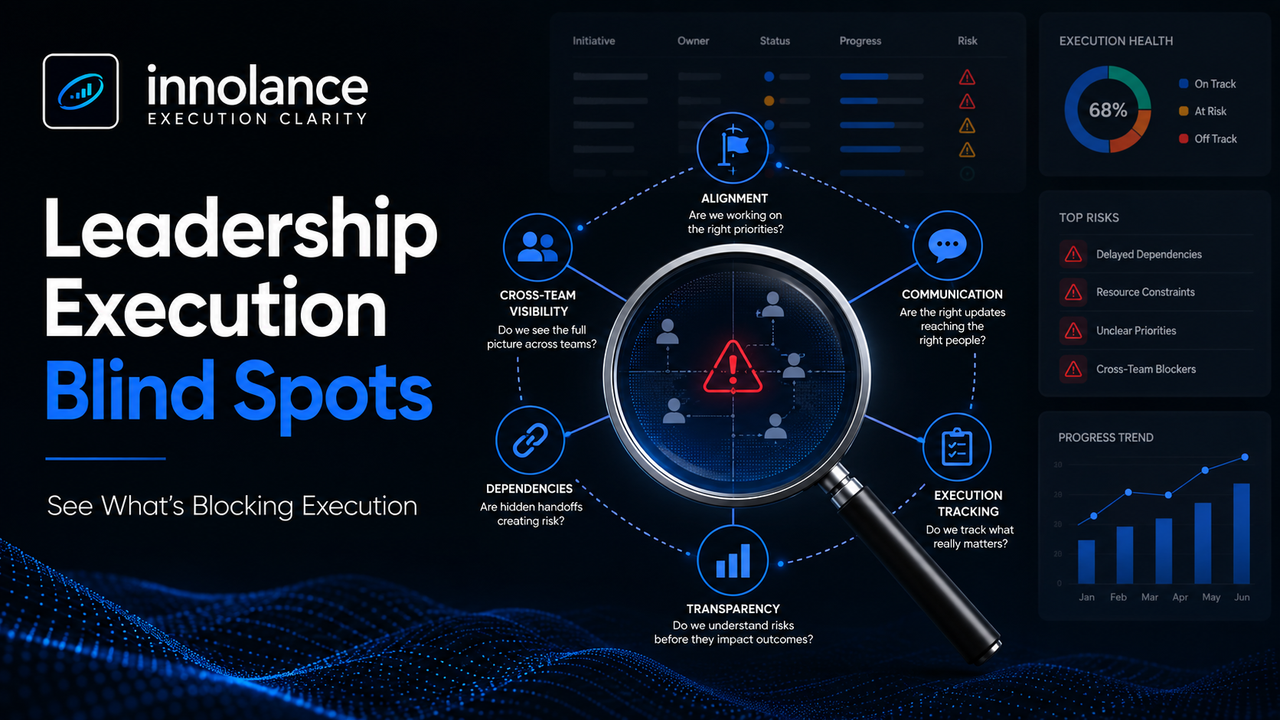
Learn how software leaders can diagnose execution visibility gaps across teams, uncover alignment and communication breakdowns, and improve execution tracking.
How to Diagnose Leadership Execution Blind Spots
Executive Summary
Growing software companies rarely lack data. Leaders often have dashboards, sprint reports, project updates, and status meetings. Yet they may still struggle to answer a critical question: Where is execution actually breaking down?
This is an execution visibility problem.
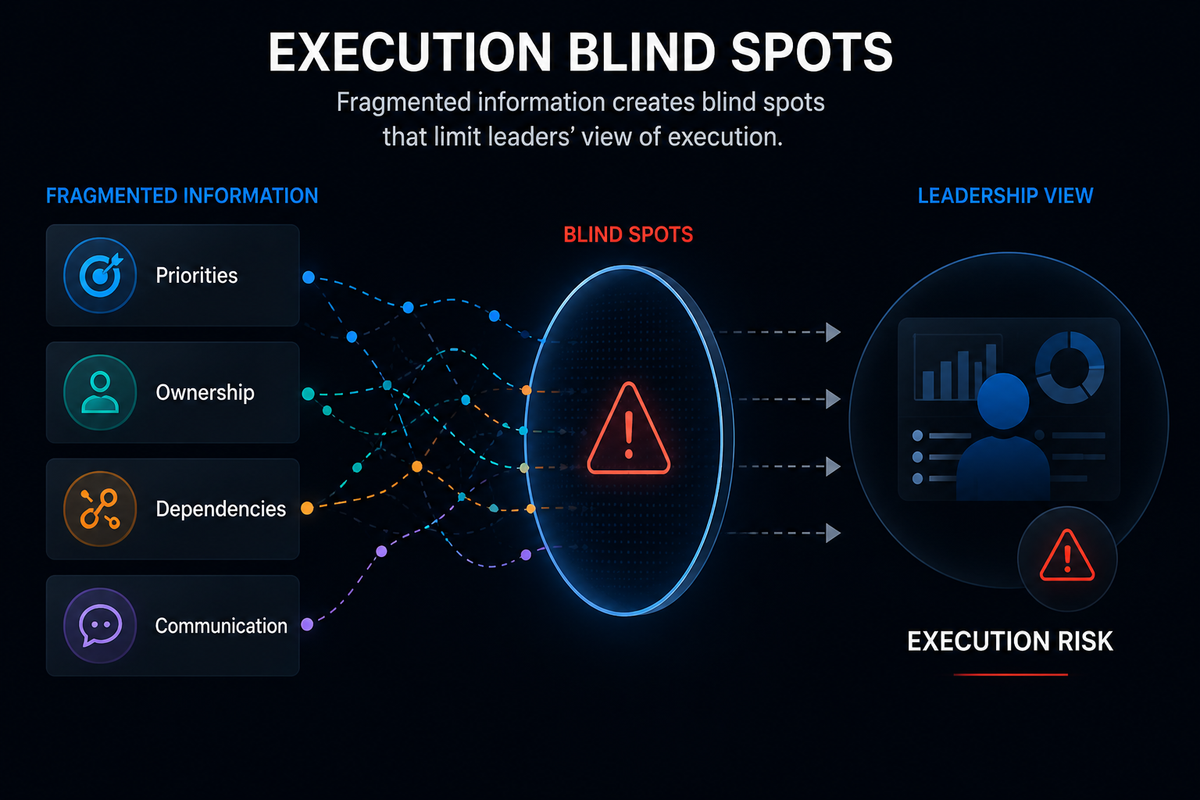
Poor execution visibility occurs when information about priorities, ownership, dependencies, decisions, and risks becomes fragmented across teams. Leaders may see individual updates without understanding how those activities connect to broader delivery outcomes.
Improving visibility requires more than another dashboard. Leaders need to diagnose where alignment, tracking, communication, and cross-team coordination are breaking down.
Direct Answer: Leaders can improve execution visibility by identifying where information becomes fragmented, validating priority and ownership alignment, mapping dependencies, examining communication and decision flows, and establishing consistent execution tracking.
Why Do Leadership Teams Lack Visibility Into Execution?
As software organizations grow, execution becomes increasingly distributed across engineering, product, operations, customer success, and leadership.
Each function may use different tools, reporting methods, and success measures. Individual teams can appear productive while leadership lacks a reliable picture of overall execution health.
Common warning signs include:
- Conflicting status updates
- Unclear ownership
- Hidden cross-team dependencies
- Frequent priority changes
- Delayed decisions
- Inconsistent execution tracking
- Risks appearing only after commitments slip
The problem is often not a lack of reporting. It is the inability to connect fragmented information into a clear picture of what is happening, why it is happening, and where leadership attention is required.
How Can Leaders Diagnose Execution Visibility Gaps?
A practical diagnosis can follow five steps.
1. Validate Priority Alignment
Start by determining whether leadership and delivery teams share the same understanding of the organization's most important priorities.
Ask:
- What outcomes matter most?
- Which initiatives support those outcomes?
- Who owns each priority?
- How are competing priorities resolved?
If different teams provide significantly different answers, the organization may have an alignment problem before it has a tracking problem.
Clear priorities create the foundation for meaningful leadership visibility.
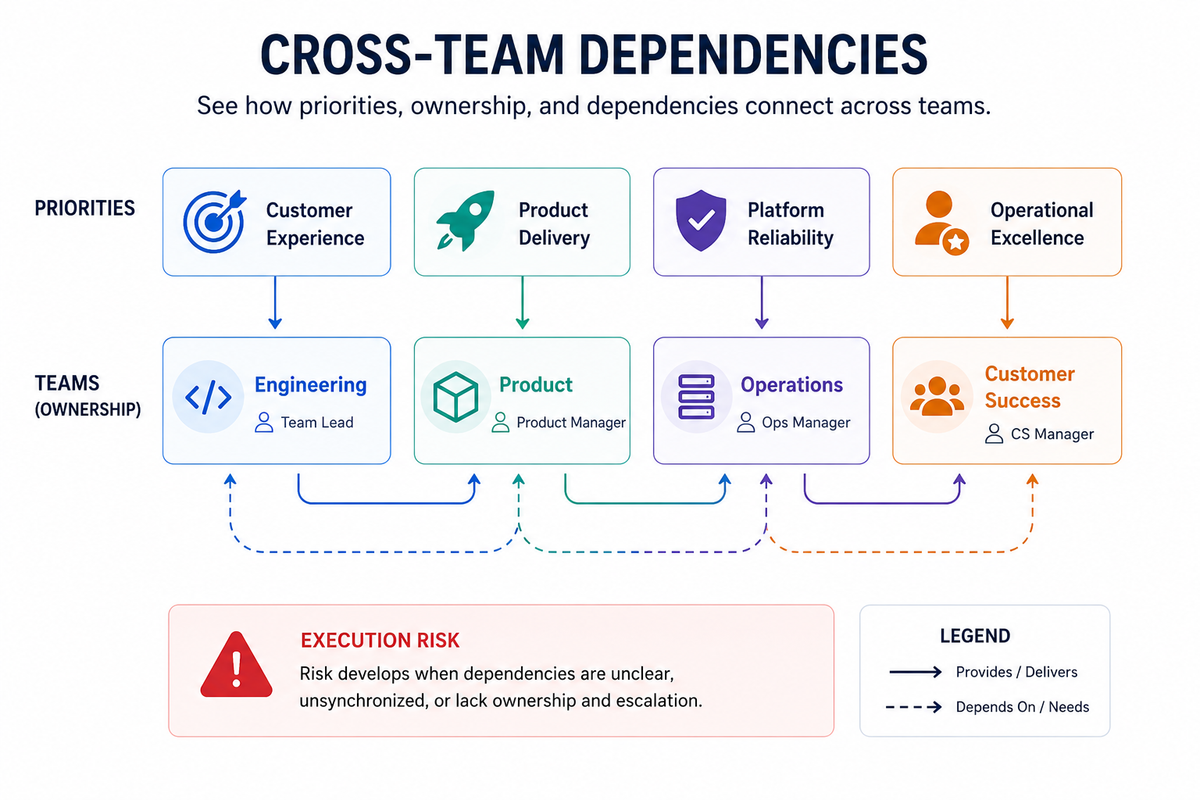
2. Map Cross-Team Dependencies
A team can execute effectively and still miss a commitment because another team's work, decision, or resource is required.
Leaders should identify critical dependencies across product, engineering, operations, and other functions. They should also determine whether every dependency has clear ownership and escalation paths.
This creates cross-team visibility into risks that isolated team dashboards may overlook.
3. Examine Execution Tracking
Next, determine whether the organization is tracking execution or simply collecting status updates.
Effective execution tracking should connect:
Priority → Owner → Progress → Dependency → Risk → Outcome
A project labeled "on track" provides limited insight if leaders cannot see unresolved dependencies, pending decisions, or emerging risks.
Tracking should therefore provide context around progress rather than simply displaying task counts, percentages, or completed work.
4. Diagnose Communication and Decision Flow
Execution visibility depends on whether important information reaches the right people at the right time.
Leaders should examine:
- How are delivery risks escalated?
- Where are important decisions recorded?
- How quickly are blockers resolved?
- Are changes communicated consistently?
- Do affected teams receive the same direction?
Communication breakdowns can leave critical information trapped within individual teams. Leadership may not recognize the impact until delivery performance begins to decline
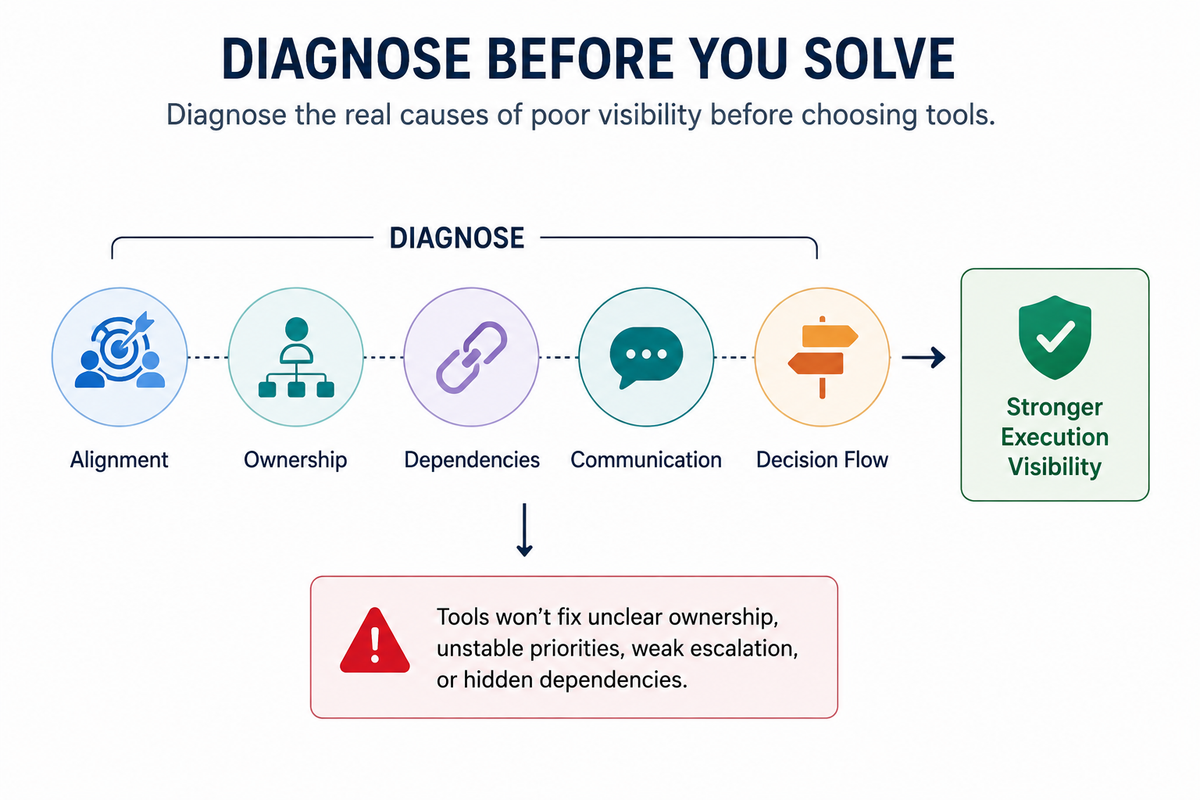
5. Identify Root Causes Before Adding Tools
When visibility is poor, another dashboard may appear to be the obvious solution.
But technology cannot automatically resolve unclear ownership, unstable priorities, weak escalation paths, delayed decisions, or hidden dependencies.
Before introducing another tool or reporting process, leaders should determine why visibility is breaking down.
Diagnosing first prevents organizations from digitizing an execution problem instead of solving it.
How Do You Improve Execution Visibility Across Teams?
Once leaders understand the root causes, they can focus improvements on the areas creating the greatest execution risk.
A practical progression is:
Diagnose → Align → Connect → Track → Improve
Diagnose where visibility breaks down.
Align teams around priorities, outcomes, and ownership.
Connect dependencies and information across functions.
Track execution through consistent, meaningful signals.
Improve the constraints preventing reliable execution.
This approach strengthens organizational transparency without creating unnecessary reporting overhead.
The goal is not for leaders to monitor every task. It is to provide enough visibility to recognize emerging risks, understand dependencies, and make timely decisions.
How Does Execution Clarity Strengthen Leadership Visibility?
Execution visibility becomes more valuable when leaders can connect delivery signals with the organizational conditions producing them.
This is where Execution Clarity becomes important.
At Innolance, Execution Clarity looks beyond isolated delivery metrics to understand how leadership, portfolio planning, communication, dependencies, and team execution interact.
ExecLens™ helps organizations assess execution maturity, validate suspected gaps, and uncover constraints that traditional reporting may overlook. Rather than assuming that additional reporting or tooling will solve the problem, leaders gain a clearer starting point for prioritizing improvements.
Those insights can then support structured improvement through Innolance's Predictable Delivery Program (PDP) and continuous measurement.
What Should Leaders Do Next?
CTOs, COOs, and delivery leaders should evaluate whether their current reporting provides genuine execution visibility or simply summarizes activity.
Start with three questions:
Can we see where execution risk is developing?
Can we explain why it is developing?
Can we identify who needs to act next?
If any answer is unclear, the organization may have an execution visibility gap worth diagnosing.
Key Takeaways
- Execution visibility connects priorities, ownership, dependencies, risks, and outcomes.
- More dashboards do not automatically create stronger leadership visibility.
- Hidden dependencies and communication gaps can create significant cross-team delivery risk.
- Effective execution tracking provides context, not just status.
- Leaders should diagnose root causes before adding tools or processes.
- Execution Clarity turns fragmented delivery information into actionable insight.
Conclusion
Leadership execution blind spots rarely result from having no information. They emerge when critical information becomes fragmented across teams, systems, priorities, and decisions.
Improving execution visibility starts by identifying where that fragmentation occurs. By examining alignment, dependencies, tracking, communication, and decision flow, leaders can uncover the root causes preventing a clear view of execution.
Greater Execution Clarity enables growing software organizations to strengthen team alignment, leadership visibility, organizational transparency, and decision-making creating a stronger foundation for predictable delivery.