
CRM Workflow Breakdowns During Rapid Growth
Learn what causes CRM workflow breakdowns during rapid growth and how cleaner processes, automation, and clear ownership improve revenue operations.
Executive Summary
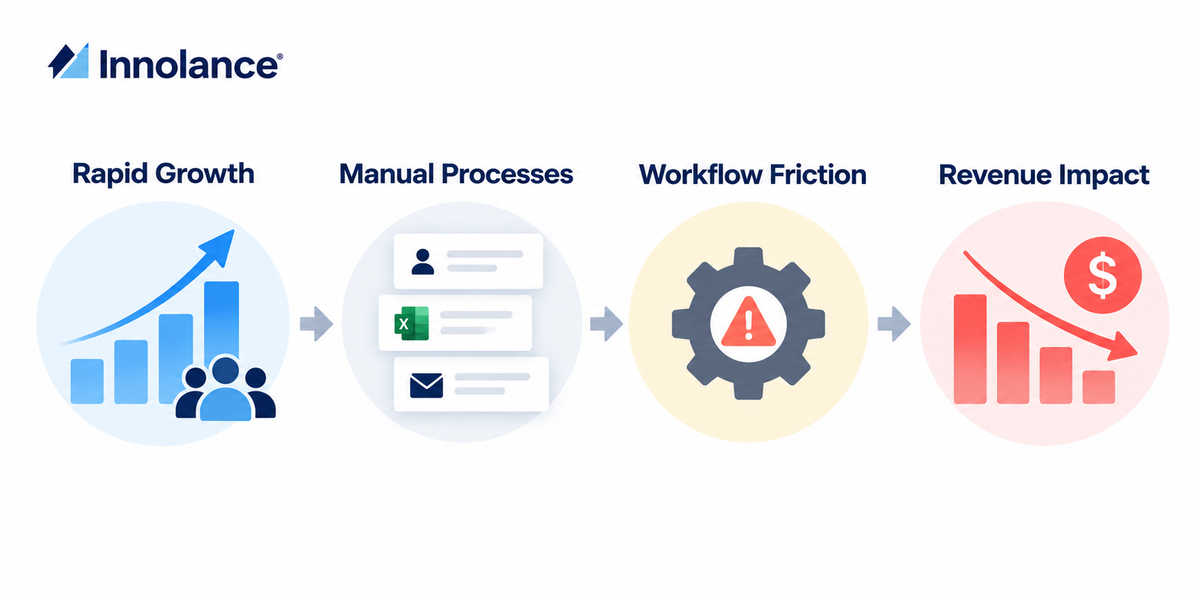
Rapid growth can expose CRM processes that worked when sales teams were smaller but cannot support increasing users, lead volume, territories, and handoffs. What begins as minor manual work can quickly become inconsistent data, unclear ownership, delayed follow-up, and unreliable reporting.
For revenue operations leaders, preventing these problems requires more than adding automation. CRM processes must first be designed to scale.
Direct Answer: CRM process inefficiency during rapid growth is commonly caused by excessive manual work, inconsistent data standards, unclear ownership, broken handoffs, and outdated automation. RevOps leaders can prevent these breakdowns by standardizing processes, defining ownership, automating repeatable activities, and regularly reviewing workflow performance.
Why Does Rapid Growth Expose CRM Process Problems?
A CRM process that works for a small sales organization may struggle as headcount and transaction volume increase.
New hires create more users, data entries, handoffs, and interpretations of the sales process. Without clear standards, representatives may update fields differently, create workarounds, or skip important steps.
These rapid hiring challenges turn small process inconsistencies into larger operational problems.
Key Takeaway: Growth does not necessarily create CRM inefficiency it exposes processes that were not designed to scale.
1. Too Many Manual CRM Processes
Manual updates may seem manageable with a small team. At scale, they become a major source of friction.
Reps may manually update lifecycle stages, lead statuses, owners, activities, and opportunity information. The more manual decisions required, the greater the risk of outdated or inconsistent data.
Manual CRM processes also consume selling time and make reporting dependent on individual user behavior.
Prevent it: Automate repetitive updates where rules are clear while retaining human review for decisions requiring judgment.
2. Inconsistent CRM Data Standards
Rapid hiring can introduce different interpretations of fields, stages, and required information.
When naming conventions vary, required fields remain incomplete, or duplicate records accumulate, automation and reporting become less trustworthy.
Prevent it: Establish clear definitions, required fields, ownership rules, and validation standards before expanding CRM usage.
3. Unclear Lead and Opportunity Ownership
Growth often introduces new territories, products, teams, and specialized roles. Without updated routing rules, leads may remain unassigned, move unnecessarily between teams, or reach the wrong representative.
This creates slower response times and inconsistent customer experiences.
Prevent it: Design routing around explicit criteria such as geography, account type, product, lifecycle stage, and representative capacity.
4. Broken Sales Handoffs
Broken sales workflows frequently occur where responsibility moves between marketing, SDRs, account executives, and customer success.
If the CRM does not clearly define when a handoff occurs, who owns the next action, and what information must accompany it, work can stall between teams.
Prevent it: Map critical handoffs and define triggers, ownership, required information, and next actions for each transition.
5. Automation That No Longer Matches the Process
Automation reduces manual effort only when it reflects the current operating model.
As organizations change, older workflows may continue assigning owners, updating fields, sending notifications, or creating tasks using outdated rules. Multiple automations can also conflict.
Effective CRM workflow management therefore requires ongoing governance.
Prevent it: Regularly audit workflows, remove redundant automation, document dependencies, and confirm that rules still reflect current processes.
How Can Revenue Operations Diagnose CRM Inefficiency?
RevOps leaders should look for recurring patterns rather than isolated user errors.
Ask:
- Which updates still depend on manual entry?
- Where do leads or opportunities wait?
- Which fields are frequently incomplete?
- Where does ownership become unclear?
- Which workflows repeatedly create exceptions?
- Can leaders trust reports without manual reconciliation?
These questions reveal where process design and system configuration are becoming disconnected.
How Does Execution Clarity Improve CRM Workflows?
Execution Clarity the ability to understand where execution is breaking down and why helps leaders identify process bottlenecks, strengthen ownership, and make informed decisions before workflow problems affect revenue execution.
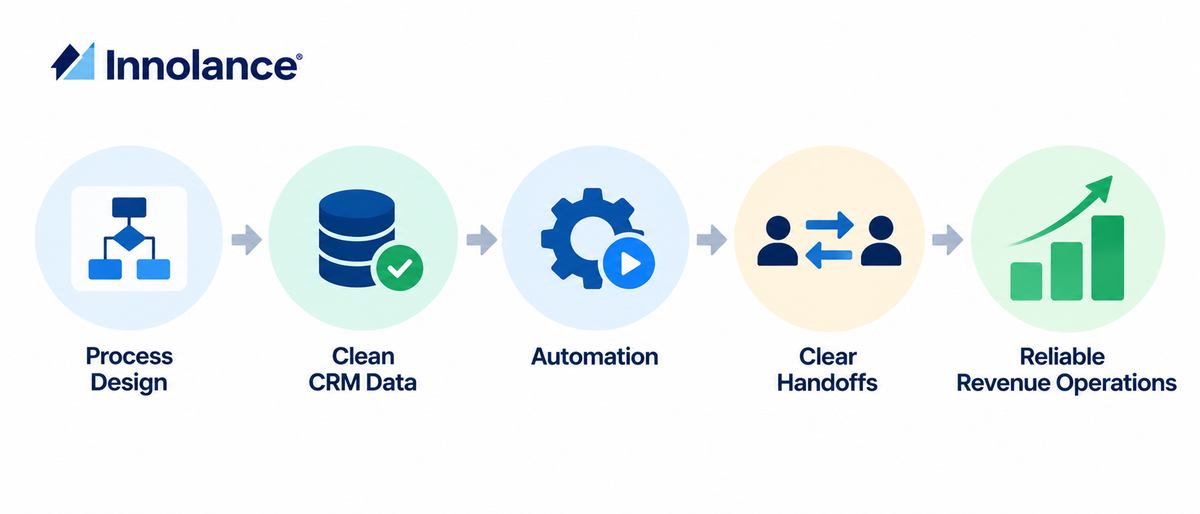
For RevOps, this means connecting process design, CRM data, automation, handoffs, and team execution rather than treating each issue independently.
What Should RevOps Leaders Do Next?
Do not start by automating every manual activity. First identify stable processes, standardize data and ownership rules, and determine where handoffs repeatedly fail.
Then automate repeatable decisions and monitor whether workflows continue to support growth.
Better automation starts with cleaner process design.
Conclusion
CRM breakdowns during rapid growth rarely come from one workflow. They develop as manual processes, inconsistent data, unclear ownership, broken handoffs, and outdated automation accumulate.
By diagnosing these conditions early, RevOps leaders can reduce CRM process inefficiency, strengthen workflow management, and build scalable revenue operations.