
From less than 50% to over 90% delivery predictability without adding headcount
From Unpredictable Delivery to Reliable Outcomes
A U.S.-based fintech organization was struggling with low delivery predictability, inconsistent outcomes, and declining stakeholder confidence.
Despite active teams and continuous effort, delivery timelines were unreliable, quality issues were frequent, and leadership lacked visibility into execution.
Through a structured execution clarity assessment and a 90-day Predictable Delivery Program, the organization achieved:
Improved from less than 50% to over 90%, enabling reliable planning and stakeholder confidence.
Delivery throughput increased across teams without adding resources or expanding headcount.
Significant reduction in defects and rework through clearer expectations and acceptance criteria.
Restored trust through better visibility into execution progress and reliable delivery outcomes.
Improved morale and engagement by reducing pressure, confusion, and firefighting.
Delivered performance improvement without adding headcount or complex transformations.
Why Delivery Timelines Keep Slipping
The organization had a cross-functional delivery team supporting nearly 15 business stakeholders. Despite strong effort, delivery reliability remained low:

Business priorities were defined at a high level but not refined collaboratively. No shared ownership between business and delivery teams, and execution alignment was weak across stakeholders.
Work was delivered with unclear expectations. Acceptance criteria were not consistently defined, leading to rework and delays becoming common.
Delivery was driven through command-and-control leadership. Teams had low autonomy and declining morale, with senior leaders focused on firefighting instead of strategic work.
This was not a capability issue. The teams were skilled and committed. The real problem was the execution system, which required a structured execution diagnosis to understand what was actually happening across teams. The organization needed to identify the gaps in execution alignment and system coordination that were slowing delivery.
Lack of Shared Understanding: Business and delivery teams operated with different expectations. There was no common understanding of priorities or outcomes, leading to misalignment and rework.
No Clear Definition of Ready or Done: Work entered delivery without clarity. Acceptance criteria were inconsistent, causing confusion about what “done” actually meant.
Weak Cross-Team Coordination: Prioritization was fragmented across stakeholders. Collaboration during planning was limited, creating bottlenecks and delays.
No Structured Delivery System: There was no consistent delivery cadence, poor visibility into work in progress, and lack of flow across teams.
How to Improve Delivery Predictability in Software Teams
To address these challenges, the organization followed a structured and practical approach focused on improving execution clarity and delivery performance.
A detailed assessment was conducted through interviews across leadership and delivery roles. The focus was to understand how work was actually being planned, prioritized, and delivered. This helped identify root causes of delivery inefficiencies, gaps in execution alignment, and constraints affecting delivery reliability.
Based on the assessment, a structured 90-day Predictable Delivery Program was implemented, focused on improving execution alignment, delivery flow, and cross-team coordination across the organization. This approach reflects how organizations can improve delivery predictability without relying on additional hiring or complex transformations.
Alignment and Prioritization: Introduced a unified prioritization model, established a Senior Product Owner role, and enabled shared ownership across business and delivery teams.
Ways of Working and Capability Building: Upskilled teams on execution fundamentals, provided role-based support for Product Owners and Scrum Masters, and shifted from directive to collaborative delivery.
Work Structure and Quality Standards: Defined clear Definition of Ready (DoR), Definition of Done (DoD), and established shared acceptance criteria.
Flow and Delivery System: Defined discovery and delivery workflows, introduced WIP limits to improve focus, and established structured planning and tracking routines.
Measurement and Transparency: Introduced delivery performance metrics, enabled visibility into execution progress, and conducted regular reviews with leadership.
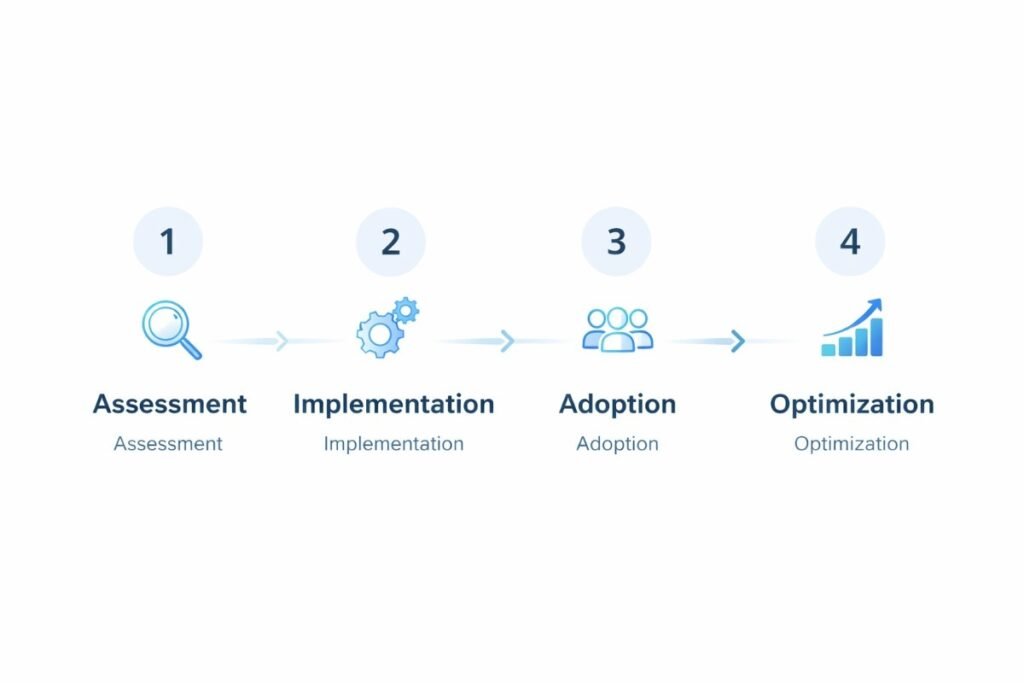
The 90-day program was designed to create sustainable improvements through structured phases:
Improving Execution Alignment and Cross-Team Coordination
The organization saw a shift from reactive execution to structured, predictable delivery.
Shared ownership between business and delivery teams, reduced dependency on micromanagement, and improved stakeholder participation in planning and execution.
Measurable Delivery Performance Improvement
| Metric | Before | After | Impact |
|---|---|---|---|
| Delivery Predictability | <50% | >90% | +40% improvement |
| Delivery Throughput | Baseline | Increased | More reliable planning |
| Defect Rate | High | Significantly Reduced | Improved quality |
| Rework | Common | Minimal | Clearer requirements |
| Stakeholder Confidence | Declining | Restored | Better visibility |
| Team Morale | Low | Improved | Reduced pressure |
| Headcount Added | N/A | 0 | Cost efficient |
Delivery predictability improved from less than 50% to over 90%, delivery throughput increased, and planning became more reliable and confident.
Significant reduction in defects, improved clarity in requirements, and reduced rework through better-defined acceptance criteria.
Improved visibility into delivery progress, better understanding of priorities, and restored trust across stakeholders.
Improved morale and engagement, reduced pressure and confusion, and increased ownership and autonomy.
Faster and more reliable time-to-market, improved execution alignment, and reduced delivery friction.
Sustainable improvement achieved without adding headcount or requiring complex transformations.
How to Fix Unreliable Delivery in Product Teams
Delivery problems are often system problems, not people problems. The issue is rarely about effort or talent, it is about structure, clarity, and coordination.
Delivery predictability is achievable through structured execution clarity, aligned teams, and transparent systems. Organizations that invest in these fundamentals see dramatic improvements in delivery performance, quality, and stakeholder confidence—without adding headcount or complexity.
If your organization is experiencing missed commitments, poor alignment, or limited visibility into delivery progress, the first step is gaining clarity on what is actually causing these issues.
At Innolance, we work with growing teams to identify the root causes behind unpredictable delivery and implement practical changes that improve execution without adding headcount.