
The Execution Intelligence Platform for Growing Organizations
As organizations grow, execution becomes harder to see and harder to manage. Teams multiply, product portfolios expand, systems evolve, and dependencies increase across the organization. What once worked when a company was smaller often becomes difficult to coordinate at scale.
Leadership teams may set clear strategic priorities, yet the day-to-day execution required to deliver those priorities becomes increasingly complex. Work moves across multiple teams, initiatives compete for attention, and coordination challenges emerge between product, engineering, operations, and business stakeholders.
In many organizations, the problem is not a lack of strategy. The problem is a lack of execution clarity.
ExecLens was created to help leaders understand why execution slows, where delivery becomes unstable, and what organizational constraints must be addressed to restore predictable value delivery.
ExecLens analyzes execution signals across teams, planning practices, coordination patterns, and leadership systems to reveal the structural issues preventing strategy from translating into consistent results.
Why Execution Breaks Down as Organizations Scale
Execution challenges rarely appear suddenly. They tend to emerge gradually as organizations grow.
At early stages, teams are small, communication is direct, and priorities are easier to align. Work moves quickly because decision-making is concentrated and coordination overhead is low.
As organizations expand, however, complexity increases rapidly.
New teams are formed to support growth. Product lines multiply. Dependencies emerge between groups responsible for different components of the delivery system. Governance layers are added to support decision-making and resource allocation.
Over time, these structural changes introduce new challenges:
Teams depend on one another to complete work
Planning cycles become more complicated
Decision rights become less clear
Delivery timelines become harder to predict
Leadership teams may still receive progress reports and dashboards, but these tools often fail to reveal the deeper structural issues slowing delivery.
Teams experience these challenges daily. Leaders, however, often see only the surface symptoms.
ExecLens helps bridge this visibility gap.
What ExecLens Reveals
Team Delivery Score (TDS)
The Team Delivery Score measures how consistently delivery teams execute planned work.
Stable delivery requires more than technical capability. It requires clarity of goals, disciplined work management, predictable flow, and shared understanding of priorities.
The Team Delivery Score reflects signals related to execution discipline within delivery teams, including how effectively work is defined, how consistently commitments are completed, and how stable delivery pace remains over time.
When this score is strong, teams are able to focus on delivering outcomes without constant disruption. When it declines, leaders may observe missed commitments, growing rework, or increasing unpredictability in delivery.
Understanding team-level execution stability provides leaders with an early signal of potential delivery challenges.
Execution Stability Index (ESI)
The Execution Stability Index measures the stability of the broader delivery system.
Even when individual teams perform well, systemic conditions can introduce instability into delivery outcomes. Changes in priorities, coordination challenges between teams, governance delays, and delivery pressure can all affect execution predictability.
The Execution Stability Index identifies systemic execution risks that reduce delivery reliability. These signals help leaders understand whether delivery instability is temporary or rooted in structural issues within the organization.
When execution stability declines, delivery timelines become harder to forecast, coordination effort increases, and teams may spend more time managing complexity than delivering value.
This metric helps leaders recognize when the execution system itself needs improvement.
Organizational Clarity Index (OCI)
The Organizational Clarity Index measures whether the organization provides the conditions necessary for predictable value delivery.
Effective execution depends on more than teams and processes. It also depends on how leadership structures decision-making, governance, organizational alignment, and strategic priorities.
When these systems are clear and aligned, teams can operate with confidence and autonomy. When they are not, execution slows as teams navigate conflicting priorities, unclear ownership, or delayed decisions.
The Organizational Clarity Index evaluates these systemic conditions and highlights whether leadership systems enable or constrain delivery performance.
Together with the other ExecLens metrics, this index helps leaders understand how organizational structure influences execution outcomes.
How the ExecLens Diagnostic Works
ExecLens gathers execution signals from across the organization to provide a balanced and objective view of how work actually moves through the delivery system.
The diagnostic process is designed to capture insights from leadership teams, product leaders, and delivery teams. These groups often experience execution challenges differently, and understanding those differences is essential for diagnosing systemic issues.
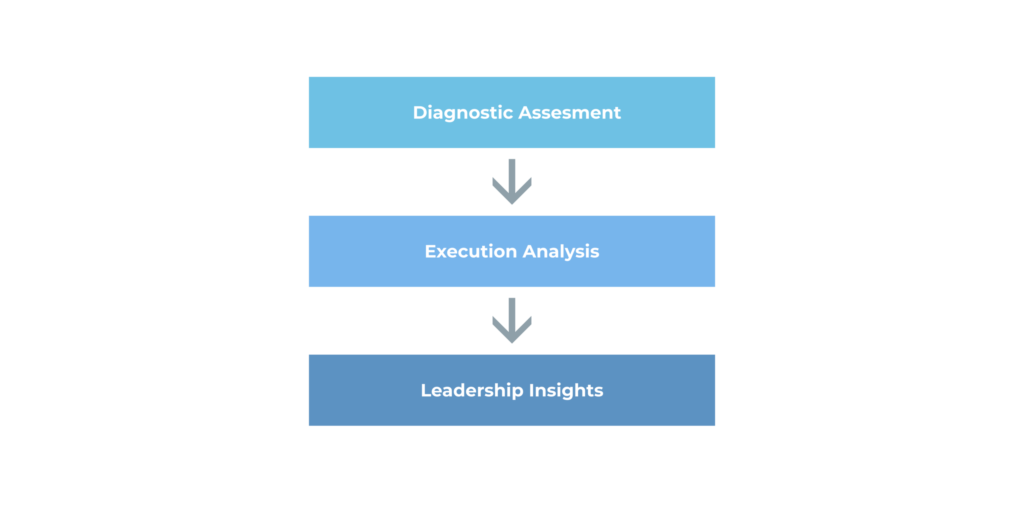
The process typically unfolds in three stages.
Step 1 — Diagnostic Assessment
Participants across leadership, product, and delivery teams complete a structured diagnostic designed to capture execution signals across the organization.
The assessment focuses on delivery practices, planning discipline, coordination patterns, and leadership systems that influence execution outcomes.
Step 2 — Execution Analysis
ExecLens analyzes the collected signals to identify patterns affecting delivery stability and organizational alignment.
This analysis highlights the systemic conditions that most strongly influence execution performance.
Step 3 — Leadership Insights
The results are presented in a structured diagnostic report that provides leadership teams with a clear view of execution stability, alignment gaps, and organizational constraints.
These insights help leaders focus improvement efforts on the structural issues that matter most.
Reveal Hidden Execution Alignment Gaps
One of the most common causes of execution problems is misalignment between leadership expectations and delivery realities.
Leadership teams often view execution through strategic progress reports and high-level metrics. Delivery teams, on the other hand, experience execution through daily coordination challenges, changing priorities, and operational constraints.
Both perspectives are valid, but they are rarely compared directly.
ExecLens analyzes signals across leadership, product, and delivery teams to identify alignment gaps that may otherwise remain invisible.
These insights help leaders understand where expectations diverge from operational reality and where systemic improvements may be required.
Addressing these gaps early helps prevent delivery instability, coordination breakdowns, and organizational friction.
When Leaders Use ExecLens
Organizations typically use ExecLens when execution challenges persist despite previous improvement efforts.
Common situations include:
Delivery timelines becoming increasingly difficult to predict
Coordination challenges emerging between teams or departments
Strategic priorities appearing clear but stalling during execution
Agile or transformation initiatives failing to produce measurable improvements
Leadership uncertainty about the root causes of delivery challenges
In these situations, organizations often attempt to introduce new tools, processes, or governance structures without first diagnosing the underlying execution system.
ExecLens provides the objective insight needed to understand what is actually slowing delivery.
By identifying the most important execution constraints, leaders can focus improvement efforts where they will have the greatest impact.
Restore Execution Clarity
Execution clarity becomes increasingly important as organizations grow and complexity increases.
Without visibility into execution stability, alignment, and organizational constraints, leaders are often forced to rely on intuition when making improvement decisions.
ExecLens provides a structured diagnostic that helps leadership teams understand how execution systems operate and where structural improvements can restore delivery performance.
If your organization is experiencing persistent delivery challenges or seeking greater clarity into execution performance, ExecLens can provide the insights needed to move forward with confidence.