CASE STUDY
How Innolance improved delivery predictability, reduced unplanned work, and helped a growing SaaS organization establish sustainable execution without adding headcount.
1
The engagement began with a structured assessment involving delivery teams and leadership. The assessment focused on understanding how work was actually being planned, prioritized, and delivered across the organization.
The Assessment Focused On:
What Leadership Gained:
| Area | Details |
|---|---|
| Industry | SaaS |
| Organization Type | Mid-sized SaaS organization |
| Primary Challenge | Overcommitment and unplanned work |
| Services Provided | Execution Clarity Assessment and Predictable Delivery Program |
| Program Duration | 90 Days |
| Focus Areas | Delivery predictability, capacity planning, workload management |
A growing SaaS company was experiencing increasing pressure on its delivery teams. As the organization scaled, delivery became harder to predict. Teams were consistently overextended, while leadership lacked visibility into actual execution capacity.
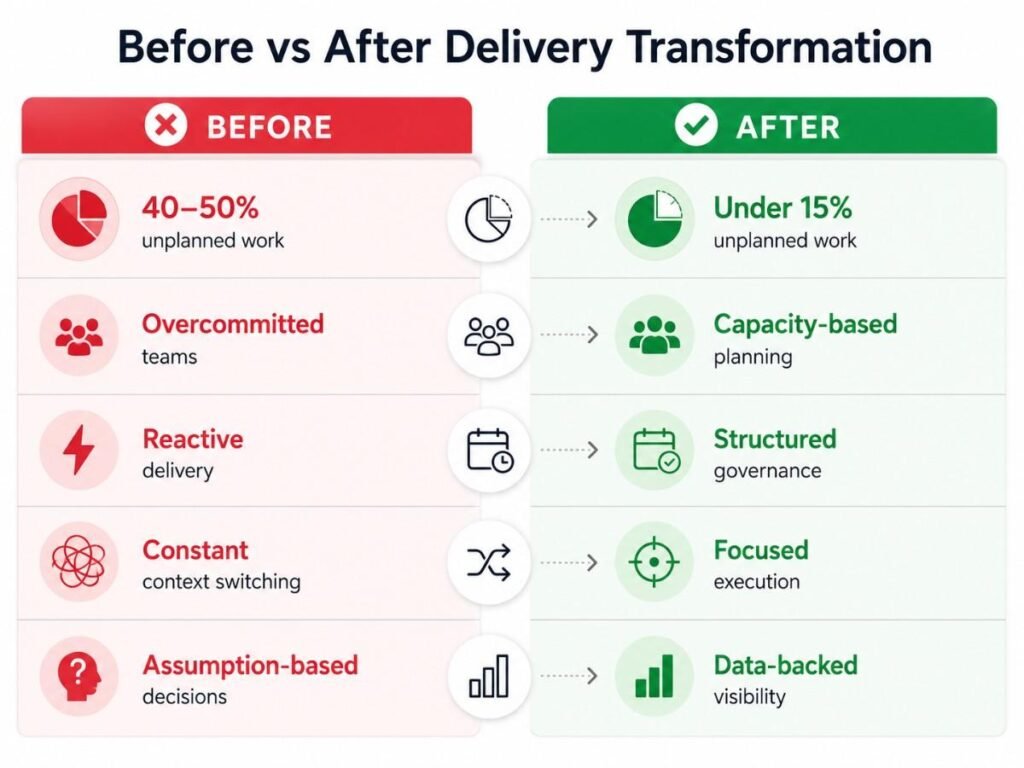
Teams were consistently planned at 30–35% above their actual capacity. This created unrealistic delivery expectations and increased pressure across teams.
Nearly 40–50% of incoming work bypassed prioritization and disrupted planned delivery. Unplanned work continuously interrupted execution flow and reduced focus on strategic initiatives.
Leadership had no clear understanding of team capacity, throughput, delivery constraints, or execution trade-offs. Without visibility into actual delivery capability, planning decisions became difficult.
Work entered the system without proper governance or alignment. Teams were forced to react to incoming requests instead of following a structured prioritization process.
Teams were overwhelmed by unrealistic expectations and constant context switching. The result was a reactive delivery environment where teams spent more time firefighting than executing planned work.
The issue was not team capability or lack of effort. The real problem was the execution system. The assessment revealed several structural issues affecting delivery predictability and execution flow.
Teams lacked a shared understanding of sustainable delivery capacity. Planning was based more on assumptions than actual performance.
Incoming work requests were not consistently reviewed or governed before entering delivery. This increased disruption and made execution harder to manage.
There was no structured method for prioritizing work across stakeholders and teams. Priorities shifted frequently, affecting delivery stability.
Leadership lacked visibility into planned work, actual delivery, capacity utilization, and execution flow. This made informed decision-making difficult.
No shared definition of "ready", no shared definition of "done", and unclear acceptance criteria. This created inconsistency across delivery teams.
The organization implemented a structured two-phase engagement focused on reducing unplanned work and improving execution clarity.
The engagement began with a structured assessment involving delivery teams and leadership. The assessment focused on understanding how work was actually being planned, prioritized, and delivered across the organization.
The Assessment Focused On:
What Leadership Gained:
Following the assessment, the organization implemented a structured 90-day Predictable Delivery Program. The focus was on stabilizing execution and introducing a capacity-based operating model.
This phase included implementation of all key interventions and continuous improvement practices.
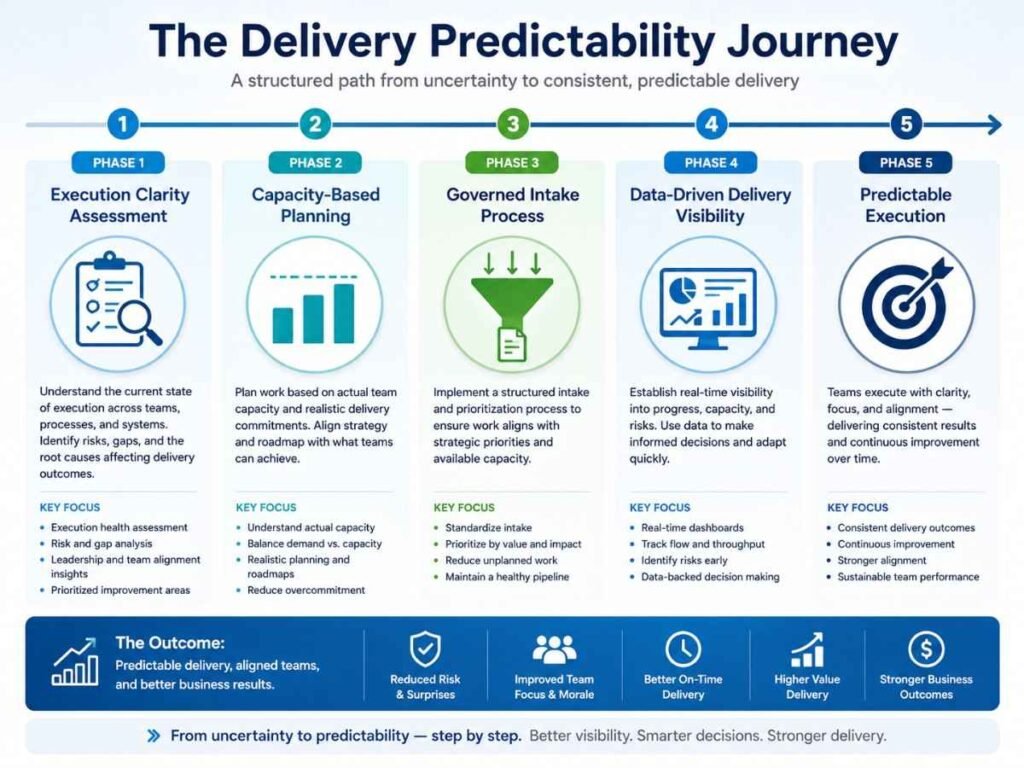
The organization shifted from assumption-based planning to planning based on actual delivery capability.
Teams were upskilled on:
A quarterly delivery roadmap aligned to team capacity and business priorities was also introduced.
A structured intake process was introduced for all incoming work.
This ensured:
The organization implemented structured prioritization approaches including:
This improved alignment between business stakeholders and delivery teams. It also enabled prioritization based on value, urgency, and effort.
The program improved visibility into:
This enabled smoother and more predictable delivery execution.
Metrics were introduced to track:
The organization replaced subjective RAG status reporting with actual delivery progress data.
Regular review cycles were introduced to:
This helped teams continuously improve execution stability over time.
From Overcommitment to Capacity-Based Execution
✖ Planning based on assumptions
✓ Planning based on actual delivery capability
This resulted in realistic planning aligned to actual capacity, a sustainable delivery pace, clear quarterly roadmaps reflecting true delivery capability, and reduced pressure from unrealistic expectations.
From Reactive Work to Governed Demand
✖ Unplanned work disrupting delivery
✓ Structured intake and prioritization
All incoming work followed a structured intake and prioritization process. Quarterly roadmaps were actively governed and maintained. Business stakeholders aligned on priorities before work entered delivery.
From Guesswork to Data-Driven Decisions
✖ Assumptions and unclear visibility
✓ Clear, data-backed insights
Leadership moved from assumptions to clear, data-backed insights. This enabled better visibility into capacity and throughput, clearer understanding of trade-offs, and more confident decision-making.
From Firefighting to Focused Delivery
✖ Constant interruption and context switching
✓ Focused execution on priorities
Teams transitioned from constant interruption to more focused execution. This resulted in reduced context switching, increased focus on high-priority work, more consistent delivery outcomes, and improved team engagement.
The organization achieved measurable improvements across delivery performance, team health, and leadership visibility.
Through structured governance of demand:
The case study revealed that execution challenges were not caused by lack of effort or capability. The primary issues were structural gaps in planning, governance, prioritization, and visibility.
Overcommitment was caused by planning beyond actual delivery capacity. Capacity-based planning created more sustainable delivery expectations.
Without structured governance, unplanned work continuously disrupted delivery flow. Structured intake and prioritization significantly reduced execution disruption.
Clear visibility into capacity, throughput, and execution flow enabled more informed leadership decisions and trade-offs.
The organization improved delivery predictability without adding headcount by implementing structured, metrics-driven execution improvements.
If your organization is overcommitting and missing delivery expectations, struggling with unplanned work and constant disruption, or lacking visibility into capacity and execution trade-offs, the first step is understanding how your execution system actually works.
An Execution Clarity Assessment can help identify the structural issues affecting delivery predictability and execution flow.